

In October 2025, I introduced the blueprint for the “Sentient Store“, aka a digital brain built on a Unified Knowledge Graph (KG).
Using the hypothetical “Mini Painter Co.” ecommerce website as a case study, I demonstrated how merging seven specialized pillars of data allowed AI agents to solve complex customer journeys with the precision of a human expert.
However, as we move into 2026, the goalposts have shifted.
The next leap in AI will not come from larger context windows, but from how models utilize memory.
A static Knowledge Graph cannot be enough to win in the age of Agentic Search. To dominate the “Reasoning Web,” brands must move from Data-at-Rest (knowing what you sell) to Data-in-Motion (remembering how and why you sell it).
For the modern SEOs and CMOs, this isn’t just a technical upgrade; it is a fundamental shift in how a brand maintains visibility.
In an era where Google’s AI Overviews/AI Mode and autonomous agents are the primary searchers, your brand’s “Visibility” depends on being the System of Record for Reasoning.
The Foundation: Operational Context and the Birth of the Agentic Team
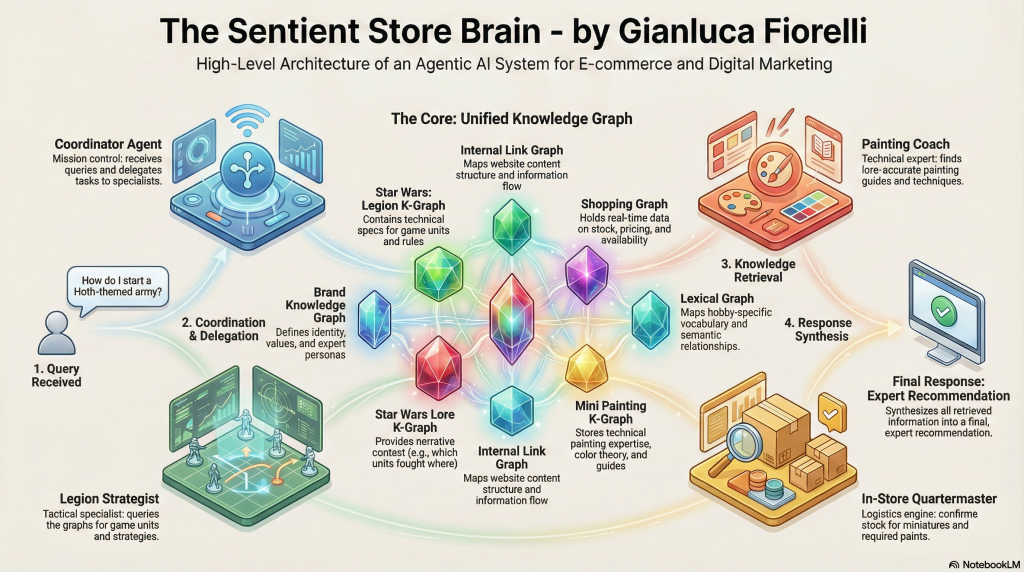
The core relationship between the original “Sentient Store” and today’s context graph frameworks is found in the architectural alignment of the seven graphs and the collaborative agent team I initially proposed.
These components provide the Operational Context, or, in other words, the foundation of identity resolution and relationship mapping that agents need to avoid “context-blindness”.
The Seven Pillars of the Mini Painter Co. Brain
My original strategy was built on seven interconnected graphs that mirror the foundational layer required for AI to understand “who owns what” and how entities relate:
- The Brand Knowledge Graph: Defines the company’s identity, values, and expert personas.
- The Star Wars: Legion K-Graph: Contains technical specifications of every unit and game rule.
- The Star Wars Lore K-Graph: Provides narrative connective tissue (e.g., which units fought on Endor vs. Scarif).
- The Internal Link Graph: Maps structural pathways of content and information flow across the domain.
- The Shopping Graph: Real-time data on stock, pricing, and transactional availability.
- The Mini Painting K-Graph: Encapsulates technical expertise, color theory, and step-by-step guides.
- The Lexical Graph: Maps specific vocabulary and semantic relationships unique to the hobby.
The Agentic Team: Context in the Execution Path
A defining feature of context graphs is that they are built and utilized within the execution path where work actually happens. Our original team of agents unknowingly set the stage for this by collaborating to solve problems in real-time:
- The Coordinator Agent: The mission control of the journey, receiving the query and delegating to specialists.
- The Legion Strategist: The tactical specialist who queries the KG for units like Rebel Commandos based on specific effectiveness and complexity scores.
- The Painting Coach: The technical expert who finds lore-accurate guides, such as our “Battle-Ready Contrast Method,” specifically for the identified units.
- The In-Store Quartermaster: The logistical engine that confirms stock for the miniatures and the specific paints required by the coach.
This multi-agent collaboration creates the Decision Traces that Foundation Capital describes, which are records that show how rules were applied and why specific actions were allowed to happen.
The Shift: Beyond Retrieval to Recursive Memory
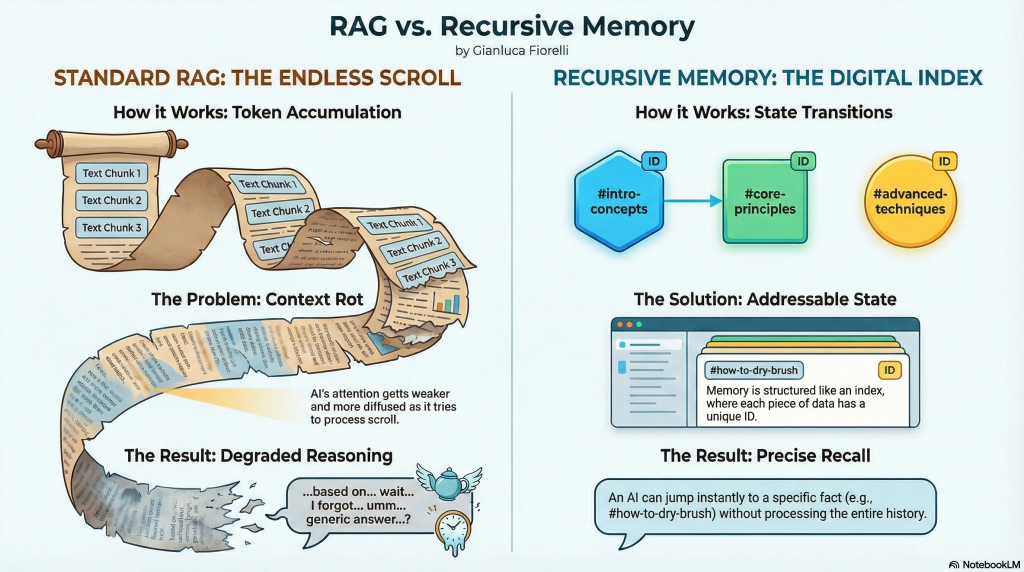
To justify the investment in a Context Graph to stakeholders, we must understand the “scientific” shift occurring in AI architecture.
We are moving from Retrieval (finding chunks) to Reasoning over Memory (navigating state).
The Scientific Theory: Memory as Addressable State
Traditional RAG (Retrieval-Augmented Generation) collapses information into tokens, leading to “context rot,” where reasoning accumulates text chunks, resulting in degraded information.
As a conversation progresses, the LLM’s attention becomes diluted, leading to hallucinations or generic answers because the model must “remember” everything within its current window.
The emerging paradigm of Recursive Language Models (RLM) reframes memory as an addressable state. Reasoning becomes a sequence of state transitions, rather than a growing prompt.
This mirrors biological memory: we don’t replay the whole book, but we jump to the right page.
In Plain English: The “Endless Scroll” vs. The “Index”
Standard RAG is like a librarian printing out every page you’ve looked at and taping them into one giant, messy roll of paper. Eventually, they lose track of what was on page one.
Addressable State, instead, is like a digital index. No matter how many questions you ask, the librarian just clicks the specific “address” for the answer. They aren’t carrying the history; they are navigating a map.
Actionable Recommendations for SEOs:
- HTML for Indexing, JSON-LD for Calculation: While classic search remains the primary driver for organic traffic and requires indexable HTML, agentic search requires calculable memory.
- Break Content into Addressable Entities: Move beyond “chunking” for vector search. Enrich your HTML so specific technical steps are discrete, addressable symbols with unique IDs (URIs).
Mini Painter Co. Practical Example
For our “Star Wars: Legion” painting guides, we do not treat them as one long document. We break “Dry Brushing” into a specific HowToStep with its own @id (e.g., mpco:technique/dry-brushing-cloaks). Then, we link this ID to the Mini Painting KGraph and the Shopping Graph.
When an agent needs to explain dry brushing after a 20-minute chat about primers and brushes, it “jumps” directly to that state rather than trying to recall it from a bloated history. This prevents Context Rot during complex follow-up questions.
The implementation (JSON-LD)
{
“@context”: “https://schema.org/”,
“@type”: “HowToStep”,
“@id”: “https://minipainter.co/guides/painting-techniques/#dry-brushing-cloaks”, // Resolvable URL + Fragment
“name”: “Dry Brushing the Camo Cloaks”,
“text”: “Using a large flat brush, remove 95% of the paint…”,
“itemListElement”: {
“@type”: “HowToDirection”,
“duringMedia”: “https://minipainter.co/videos/dry-brushing#t=60”
},
“tool”: {
“@type”: “HowToTool”,
“@id”: “https://minipainter.co/products/rebel-paint-set/#product”, // Resolvable URL + Fragment
“name”: “Rebel Alliance Paint Set”
}
}
Step 1: Solving the Operational Context Problem (Identity Resolution)
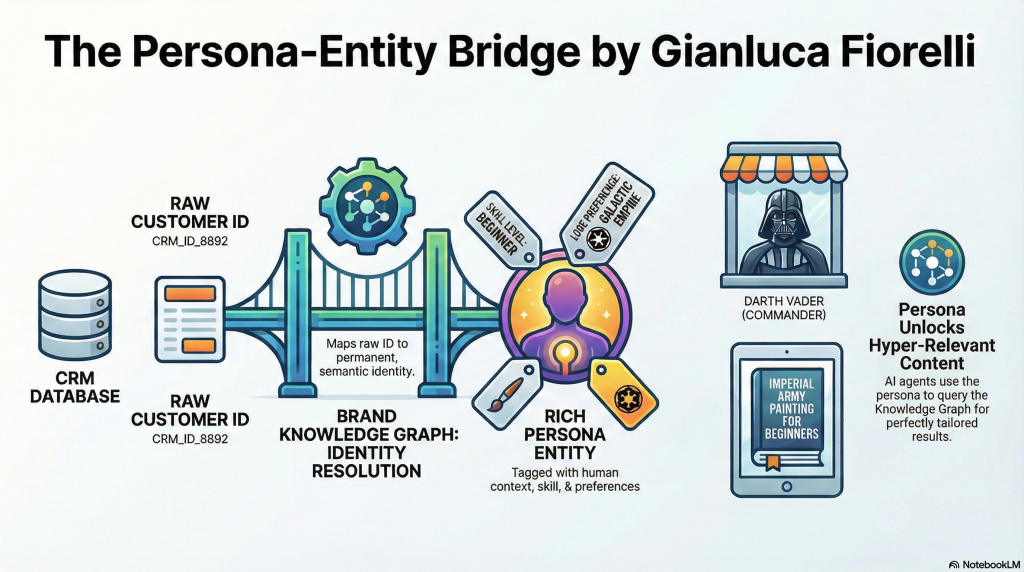
The Scientific Theory: Multi-Entity Disambiguation
Entity Resolution (ER) is the technical task of identifying and linking different mentions of the same real-world entity across multiple datasets. In a Context Graph, we solve this by using a Unified URI (Uniform Resource Identifier).
The Customer ID is the bridge. While it may originate in our CRM or Store Database (e.g., CRM_ID_8892), it is mapped within the Brand Knowledge Graph to a permanent, semantic identity: mpco:persona/ian-the-gamer. Without this unified identity layer, agents suffer from “Context Fragmentation,” losing the reasoning lineage of a customer’s journey.
In Plain English: The “Who is Who?” Problem
If “Ian the Gamer” asks for help, the AI needs to know he’s the same person who bought a “Start Collecting” set six months ago. If it doesn’t know he’s a beginner, it might recommend an advanced airbrushing guide, wasting his time and your budget.
By linking his transactional ID to a “Painting Persona,” the AI understands the human context (Beginner skill, Empire preference) behind the data.
Practical Mini Painter Co. Example
We link Ian’s transactional ID to his “Painting Persona” (Beginner) and his “Lore Preference” (Galactic Empire).
When he searches for “best units,” The Legion Strategist agent traverses the Lore Graph and Shopping Graph to find “best units for a beginner Imperial player who likes the Battle of Hoth.”
Actionable Recommendations for SEOs:
- Adopt Schema.org as Primary Keys: We use Person, Organization, and Product schemas for all data.
- Mini Painter Co. Example: We use IndividualProduct for “Darth Vader (Commander)” and ensure the brand property links directly to our Brand Knowledge Graph.
- Implement a Global Entity ID (URI): We ensure every product and persona has a URI consistent across our guides, blog, store, and support logs.
- Mini Painter Co. Example: The ID swl:luke-skywalker-jedi-knight should be used in lore blog posts, inventory databases, and internal link structures.
- Implement Anonymized Persona-Entity Bridges: To make our authority “calculable” for AI searchers without compromising privacy, we tag the intended buyer persona within our JSON-LD content. This tells Google’s and LLMs’ reasoning engines that our content is a “high-gain” solution for a specific entity type.
The Implementation (JSON-LD)
{
“@context”: “https://schema.org/”,
“@graph”: [
{
“@type”: “HowTo”,
“@id”: “https://minipainter.co/guides/imperial-beginner-basics/#how-to”,
“name”: “Imperial Army Painting for Beginners”,
“intendedAudience”: {
“@type”: “Audience”,
“@id”: “https://minipainter.co/personas/#beginner-imperial-painter”, // Addressable Persona
“audienceType”: “Beginner skill level with Galactic Empire lore preference”
}
},
{
“@type”: “IndividualProduct”,
“@id”: “https://minipainter.co/products/swl-vader-commander/#product”, // Addressable Product
“name”: “Darth Vader (Commander)”,
“subjectOf”: { “@id”: “https://minipainter.co/guides/imperial-beginner-basics/#how-to” }
}
]
}
Step 2: Building the Event Clock (Temporal Validity)
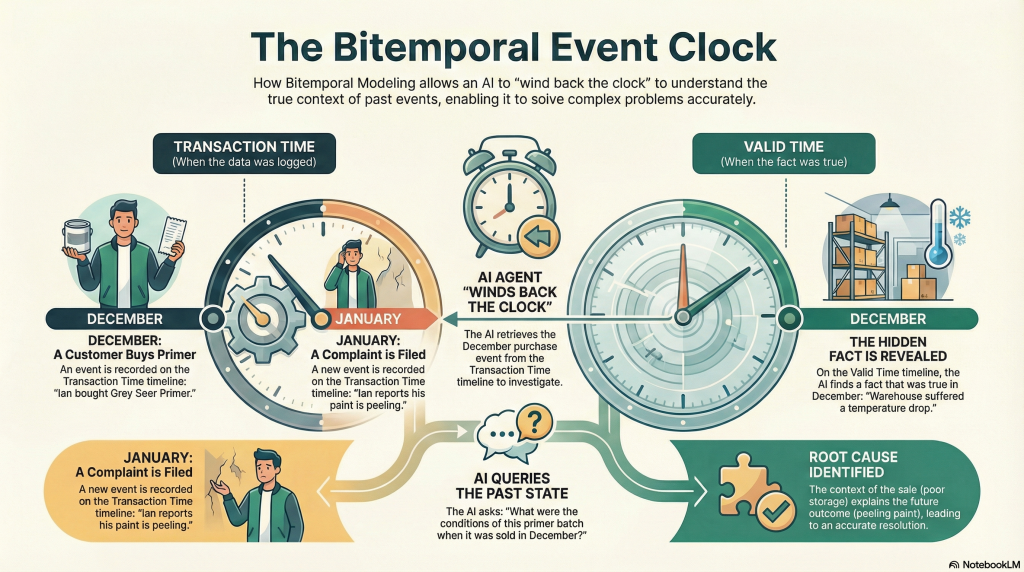
The Scientific Theory: Bitemporal Modeling and Point-in-Time Retrieval
Standard databases typically follow a uni-temporal model; they only know the “current state.”
For agentic search and recursive memory, this creates a “Context Void.” A true Context Graph requires Bitemporal Modeling, tracking two distinct timelines:
- Transaction Time (when data was recorded) and
- Valid Time (when the fact was actually true).
This enables Point-in-Time Retrieval. An agent can “wind back the clock” to understand the world state when a decision was made, preventing the model from using current data to justify past actions.
In Plain English: The “When did this happen?” Layer
Telling an AI “Rebel Commandos are in stock” is a fleeting fact.
Telling an AI, “We recommended Rebel Commandos to Ian because they were the only Endor-lore unit in stock at that specific moment,” captures a Decision Event. Without the clock, the AI can’t learn from past successes or failures because it loses the environment in which those decisions were made.
Practical Mini Painter Co. Example
Ian bought a “Grey Seer” primer in December. In January, he complains that his paint is peeling. Because we have an Event Clock, the Painting Coach agent doesn’t just look at the product; it winds back the clock to the transaction time. It sees, for instance, that in December, that specific batch of primer was stored in a warehouse that suffered a documented temperature drop. The “context” of the purchase (the weather/storage state) explains the “outcome” (the peeling paint).
Actionable Recommendations for SEOs:
1. We log “Valid-At” Metadata for All Product Attributes
Every attribute in our Shopping Graph (Price, Stock Level, Compatibility) should be treated as a temporal entity rather than a static field.
- Mini Painter Co. Example: When tracking the price of an “AT-ST” model, do not overwrite the price field. Use a PriceSpecification object with validFrom and validThrough properties.
- SEO Implementation: This data is exposed via JSON-LD on your product page. It tells external AI searchers (like Google’s Shopping Graph) that your data has high temporal accuracy, which is a significant trust signal.
2. We implement “Snapshot Context” for Agentic Tool Calls
Whenever an agent executes a task (like recommending a paint bundle), we capture a “snapshot” of the graph’s state.
- Mini Painter Co. Example: We record that “Han Solo (Endor Version)” was the only thematic leader in stock at exactly 14:32 UTC when the Coordinator Agent suggested it to Ian. We store this snapshot as an Observation linked to the Decision Trace.
- SEO Benefit: This creates Durable Evidence. When an AI model asks why our store is the authority on Endor painting, we can surface the structured data showing that our recommendations are based on real-time environmental calculations.
3. Implement a “Persistent SEO URL” vs. “Archival ID” Strategy
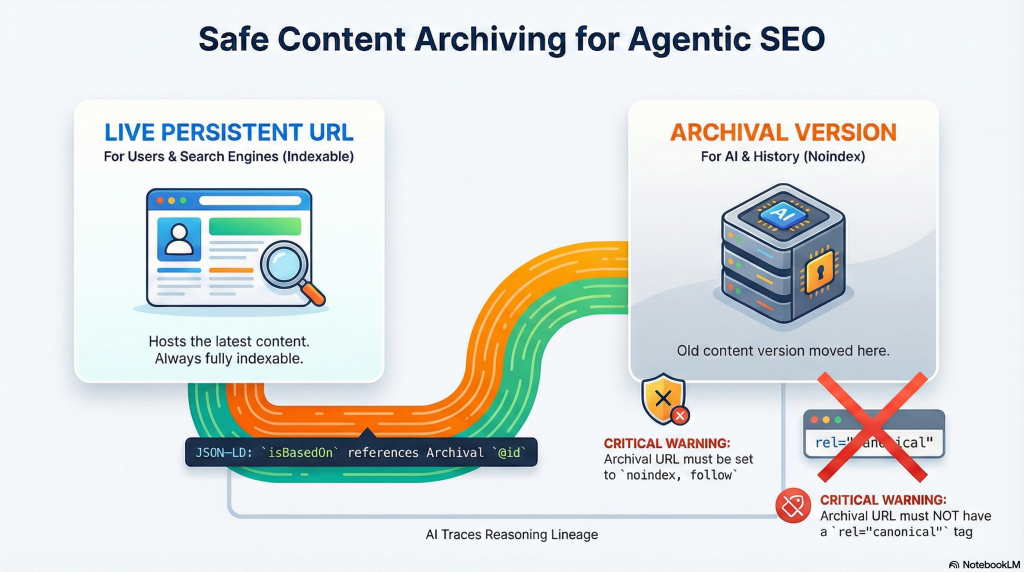
To avoid the Noindex-Canonical conflict, the substantial duplicate content risk, and maintain rankings, we must decouple the human-facing URL from the machine-facing versioning system.
- The Persistent SEO URL: We maintain a single URL for our guides (e.g., /guides/beginner-painting-rebels/). This always hosts the latest version and is fully indexable.
- The Archival Layer (Noindex, No Canonical): When a guide is updated, we move the previous version to a private/archival URL (e.g., /archive/guides/rebel-v1/).
- SEO Protection: This archival page is set to noindex, follow. Crucially, it must not contain a rel=”canonical” to the main page to prevent “noindex leakage”.
- The “Resource vs. Location” Logic: By using Fragment Identifiers (#how-to), we ensure all IDs remain resolvable. This allows the Painting Coach to “follow its nose” to the actual data on the archival page, separating the Web Page (the container) from the Entity (the knowledge).
The Implementation (JSON-LD)
1. The Archival Version (v1.0 – Noindex Page): This version uses a fragment ID to make the specific knowledge entity addressable:
{
“@context”: “https://schema.org/”,
“@type”: “HowTo”,
“@id”: “https://minipainter.co/archive/guides/rebel-v1/#how-to”,
“name”: “Painting Rebel Commandos (Archived v1.0)”,
“identifier”: “mpco:guide/rebel-painting-v1”,
“datePublished”: “2025-10-01T08:00:00Z”,
“description”: “Original 2025 method using traditional layering techniques.”
}
2. The Live Version (Latest SEO URL): The live page references the archival entity to establish a “Semantic Breadcrumb” and prove reasoning lineage:
{
“@context”: “https://schema.org/”,
“@type”: “HowTo”,
“@id”: “https://minipainter.co/guides/beginner-painting-rebels/#how-to”,
“mainEntityOfPage”: “https://minipainter.co/guides/beginner-painting-rebels/”,
“name”: “Painting Rebel Commandos: 2026 Updated Method”,
“isBasedOn”: {
“@id”: “https://minipainter.co/archive/guides/rebel-v1/#how-to”
}
}
Step 3: Capturing Decision Traces (The Reasoning Web)
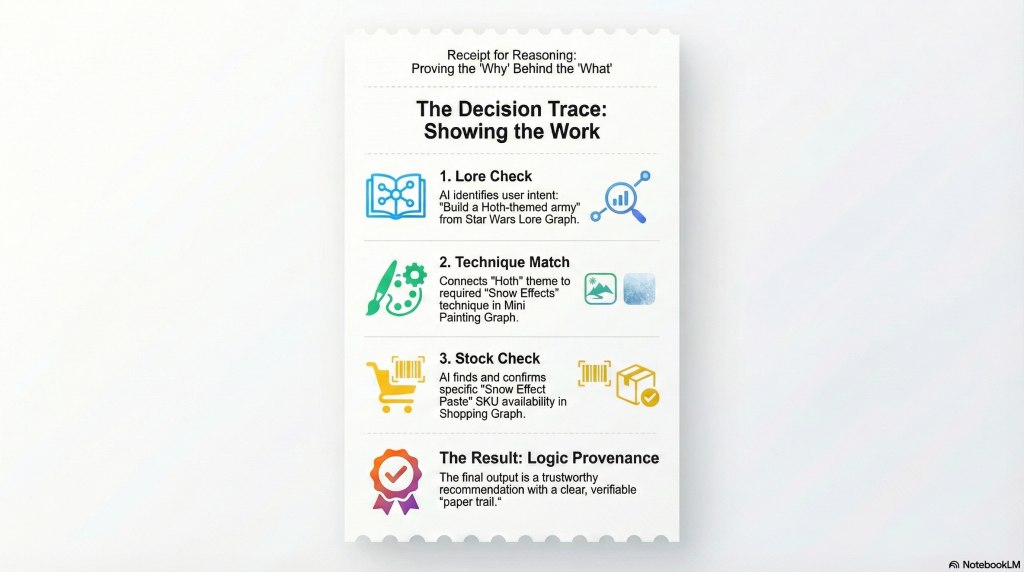
The Scientific Theory: Logic Provenance and State Transitions
In the paradigm of Recursive Language Models (RLM) and Context Graphs, reasoning is not a static output; it is a sequence of state transitions.
Every time an agent makes a choice, it moves from one “state” of knowledge to another.
A Decision Trace is the durable record of these transitions. It captures the specific inputs gathered from the Seven Graphs, the policies evaluated (e.g., “Beginner Friendly”), and the final logic applied.
This provides Logic Provenance, allowing the system to justify its actions to both human experts and external AI search engines.
In Plain English: Showing the AI’s “Work”
This is the “Why did the AI say that?” layer. Standard AI is a “black box”; it gives you an answer, but you don’t know where it came from.
A Decision Trace is like a math student showing their work.
It says: “I recommended these paints because: 1. Ian is a beginner. 2. He is painting for the Battle of Endor. 3. These Contrast paints are the most effective for that specific lore/skill intersection.“
This “why” is the most valuable proprietary data your brand owns.
Practical Mini Painter Co. Example
When the Coordinator Agent finalizes a recommendation for “Snow effect paste” for Ian, it doesn’t just log the sale. It generates a structured trace: “User is building a Hoth-themed army; snow effects are the primary thematic requirement for Hoth-based miniatures.“
This trace links the Star Wars Lore KGraph (Hoth) to the Mini Painting KGraph (Snow effects) and finally the Shopping Graph (the specific SKU).
Actionable Recommendations for SEOs:
1. Instrument the Orchestration Layer with MCP (Model Context Protocol)
We must move beyond logging “clicks” and start logging “trajectories.” We use MCP to allow our agents to write their reasoning directly back into our Internal Link Graph.
- Mini Painter Co. Example. The Legion Strategist agent logs: “Identified Rebel Commandos as the optimal unit because the user’s Persona (Beginner) matches the unit’s ‘Ease of Build’ score in the Star Wars: Legion KGraph.“
- SEO Benefit. This creates a database of Expert Reasoning. By exposing these traces to our site’s search engine, we allow users to find products based on intent rather than just keywords.
2. Convert Private Traces into “Expert Insight” Public Content
The reasoning stored in our traces is the ultimate source of Information Gain. We can use our agents to aggregate successful traces and publish them as structured data on our product and guide pages.
- Mini Painter Co. Example. On the “Rebel Commandos” product page, add a “Why Experts Recommend This” section powered by agent traces.
- SEO Benefit. This provides Unique Evidence. When an AI Model (AI Mode or ChatGPT, for instance) searches for “best rebel units for beginners,” it finds our structured reasoning, aka data that generic scrapers and LLMs do not have. This is what makes us the “Primary Source”.
3. Implement “Reasoning Lineage” in User Feedback Loops
When a user provides feedback (like a thumbs up), we will link that feedback to the specific Decision Trace that generated the recommendation.
- Mini Painter Co. Example. If Ian marks a painting guide as “Too complex,” that signal is attached to the trace. The Painting Coach then uses this to “calculate” that its definition of “Beginner” needs re-weighting in the Lexical Graph.
- SEO Benefit. Google rewards sites that demonstrate Experience, Expertise, Authoritativeness, and Trustworthiness (E-E-A-T). By showing that our AI learns from real-world human corrections, we are providing a high-confidence signal of expert-led authority.
The Implementation (JSON-LD Decision Trace Snapshot):
This is how we can “expose” a piece of reasoning to an AI crawler as an Action:
{
“@context”: “https://schema.org/”,
“@type”: “RecommendAction”,
“@id”: “https://minipainter.co/traces/8892-ian-rebels/#reasoning”,
“agent”: {
“@type”: “SoftwareApplication”,
“@id”: “https://minipainter.co/agents/#legion-strategist”, // Addressable Agent
“name”: “The Legion Strategist”
},
“object”: {
“@id”: “https://minipainter.co/products/rebel-commandos/#product” // Addressable Product
},
“description”: “Recommended for beginner Hoth-themed collection.”,
“result”: {
“@type”: “Review”,
“reviewBody”: “Matched user ‘Beginner’ skill level with unit ‘Complexity: Low’ score in Star Wars: Legion K-Graph.”
}
}
Step 4: The AI Supervisor (Navigation vs. Calculation)
The Scientific Theory: Entropy Control and Symbolic Calculation
In my 2025 blueprint, I established a high-performing team of specialist agents. However, as these agents gain autonomy, they face the risk of “Semantic Drift“, which is a phenomenon where an agent’s logic slowly detaches from reality due to the limitations of standard RAG (Retrieval-Augmented Generation).
In a RAG-only system, an agent merely predicts the next likely token based on a fuzzy, unorganized context, which inevitably leads to hallucinations.
To solve this, I introduce a new, higher-order agent: the AI Supervisor.
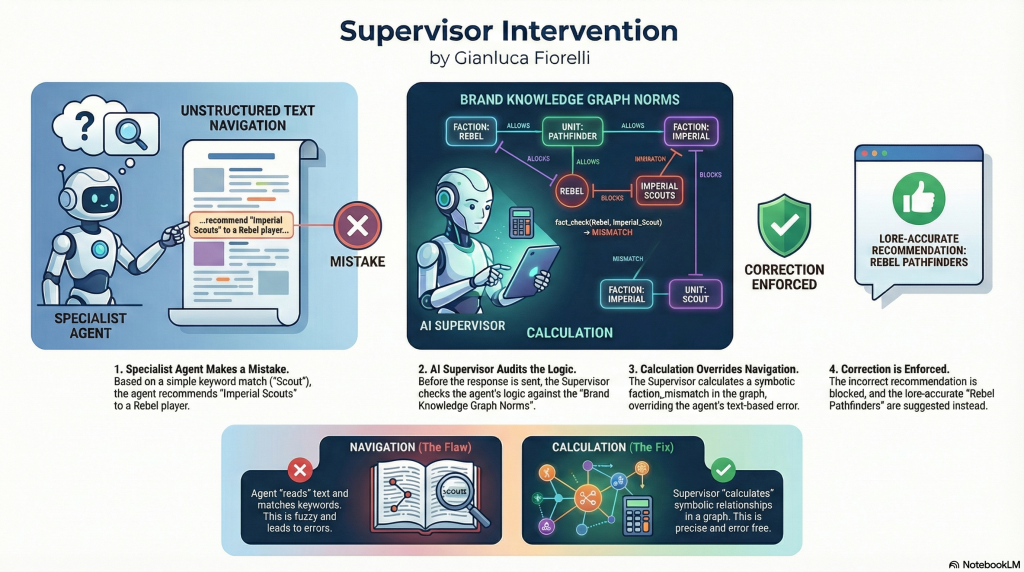
While the Coordinator Agent manages the logistics of a query (delegating tasks), the AI Supervisor manages the integrity of the reasoning. It implements Entropy Control by auditing the “Hidden Journey” of the specialist agents (the Strategist, Coach, and Quartermaster). The key architectural advantage here is the shift from Navigation to Calculation:
- HTML enables Navigation: An AI “browses” a website like a human, looking for clues in text.
- Knowledge Graphs enable Calculation: Because the Seven Graphs represent a discrete space of symbols, the Supervisor doesn’t “guess” if a suggestion is right; it calculates the validity of every state transition.
In Plain English: The “Double-Check” Layer
Standard AI is like a salesperson who is very good at talking but hasn’t read the store’s policy manual. They might accidentally promise a beginner a professional-level tool they aren’t ready for. The AI Supervisor is the store manager standing behind them. When the Painting Coach gets over-excited and suggests a medium/advanced “Wet Blending” technique to a beginner, the Supervisor sees the conflict. It doesn’t “read” the guide to find the error; it calculates the conflict against the Mini Painting KGraph and steps in: “Wait, our expert rules say we only suggest ‘Dry Brushing’ to beginners. Switch the recommendation.“
Practical Mini Painter Co. Example
- The Star Wars: Legion agent might recommend “Imperial Scouts” for a “Rebel Force” because they share a “Scout” keyword in the Lexical Graph.
- The AI Supervisor immediately calculates the relationship in the Star Wars Lore KGraph.
- It identifies the faction_mismatch and triggers an intervention, forcing the Strategist to correct the unit to “Rebel Pathfinders” before the response reaches the customer.
Actionable Recommendations for SEOs
We must define Explicit “Norms” in the Brand Knowledge Graph
Expertise is defined as much by what we don’t do as what we do. We must convert our brand’s “tacit knowledge” into Machine-Readable Norms. Crucially, these norms must live in the Brand Knowledge Graph, not the specialized data graphs.
Why the Brand KGraph?
While the Star Wars: Legion KGraph contains technical facts (e.g., unit stats), the Brand KGraph contains our “Business Logic.” By keeping norms here, we ensure they are applied globally.
If we expand our store to include Star Wars: Shatterpoint in the future, the “Beginner Safety” norm in our Brand KGraph remains constant, even as the specialized data changes.
- Mini Painter Co. Example: We create a norm entity: mpco:norm/beginner-safety stating: “If UserSkill == Beginner, exclude all products with Tag:Advanced_Technique.“
- SEO Benefit: We are providing Google’s and AI Models’ reasoning engines with the Constraints of our Expertise. This prevents our brand from being associated with “bad advice” in AI Answers.
Human-in-the-Loop: SMEs as System Auditors
The role of your Subject Matter Experts (SMEs) must evolve from content writers to System Auditors who refine the Supervisor’s logic.
- Mini Painter Co. Example. Lead experts review a weekly sample of Decision Traces. When they find a logic error that the Supervisor missed, they update the norm in the Brand KG. The Supervisor then uses this update to “re-weight” the Lexical Graph.
- SEO Benefit. Google rewards sites where human experts clearly oversee AI outputs. By documenting this oversight in your structured data (e.g., using reviewedBy on our RecommendAction traces), we provide proof of expert-led governance (E-E-A-T).
Automate Lexical Integrity Checks
We will use the Supervisor to ensure that the Lexical Graph remains consistent across all customer-facing agents.
- Mini Painter Co. Example. If an agent starts using terms from a competing franchise (e.g., “Space Marines”) to describe units, the Supervisor identifies the lexical drift and forces a correction based on the Lexical Graph.
- SEO Benefit. Consistent terminology is the backbone of Entity Authority. If our site uses correct, canonical lore terms consistently across every interaction, Googlebot more easily resolves our identity as the “Niche Authority.”
The Implementation (Supervisor Intervention Trace):
Exposing an intervention shows Google that our system is self-correcting and expert-governed:
{
“@context”: “https://schema.org/”,
“@type”: “UpdateAction”,
“@id”: “https://minipainter.co/traces/audit-992/#correction”,
“targetCollection”: {
“@id”: “https://minipainter.co/traces/8892-ian-rebels/#trace” // Addressable Trace
},
“agent”: {
“@type”: “SoftwareApplication”,
“name”: “The AI Supervisor”
},
“error”: “Lore Inconsistency: Imperial Scouts cannot lead Rebel Units.”,
“actionStatus”: “CompletedActionStatus”,
“participant”: {
“@type”: “Organization”,
“name”: “Mini Painter Co. Expert Review Board”
}
}
The implementation of the AI Supervisor Intervention Trace is not just about writing code; it is a strategic decision regarding where our brand’s “reasoning” is stored and how it is discovered by different types of search engines.
Depending on our specific SEO and visibility goals, this JSON-LD can “live” in two distinct environments:
1. The “Public Proof” Strategy (On-Page Implementation)
- Goal: To maximize the Information Gain score for classic Google Search.
- Where it lives: Directly in the HTML of a publicly accessible “Expert Audit Log” or “Transparency” page (e.g., minipainter.co/transparency/logs/audit-992/).
- The Logic: By publishing the Supervisor Intervention Trace as indexable JSON-LD, we are effectively “publishing our math.” We are showing bots that our expertise is not a static block of text, but a self-correcting, expert-governed system.
- The SEO Impact: This creates a unique URL that serves as a Primary Source of Reasoning. In an era where an inflation of redundant information exists, this documentation of a correction (e.g., why a lore error was caught) is highly valuable proprietary data.
2. The “Agentic Discovery” Strategy (API / Execution Path)
- Goal: To provide “Logic Provenance” to autonomous AI agents (like OpenAI’s “Operator” or Perplexity).
- Where it lives: This JSON-LD is served dynamically via the Model Context Protocol (MCP) or as a response object within our internal agentic infrastructure.
- The Logic: Instead of being indexed by a crawler, the trace is provided “on demand.” When an external AI agent queries our store and asks, “Why should I trust this recommendation?“, our system provides the Decision Trace and the Supervisor Audit as supporting evidence in the response header.
- The SEO Impact: It builds Machine Trust. When an agent realizes our site provides the “calculable” reasoning behind every answer, it will prioritize citing our store as the definitive authority for that niche.
The “Sentient Store” Recommendation
For an organization like Mini Painter Co., I would recommend a hybrid approach to maximize authority:
- Summarize on Product Pages: We would use a small Review or Comment schema on the product page stating that the logic was “Lore-checked by our (AI) Supervisor.”
- Deep Trace in the Archive: We would use that summary for the full Supervisor Intervention Trace hosted on a dedicated Governance Page. This ensures that the “proof” of your expertise is always one click away for both humans and machines.
The SEO Advantage: Information Gain and AI Visibility
The Scientific Theory: The Context-Based Information Gain Score
In an era of LLM-generated commodity content, visibility is no longer a volume game; it is a Synthesis Game. Google’s Patent US20200349181A1 formalizes this through the “Information Gain” score, which is a metric that rewards documents for providing unique, non-redundant information relative to what a user has already encountered in their search journey.
To maximize this score, brands must move away from traditional CMS “copy-pasting” and toward Modular Content Assembly.
In practical terms, this is a transition from a website that is a “library of articles” to a website that is a “rendering engine for a Knowledge Graph.”
This allows us to create “Context-First” pages that provide “Calculable Addressable State”, which is the holy grail for autonomous agents like Perplexity or OpenAI’s “Operator”.
The Practical Workflow: From Query to Render
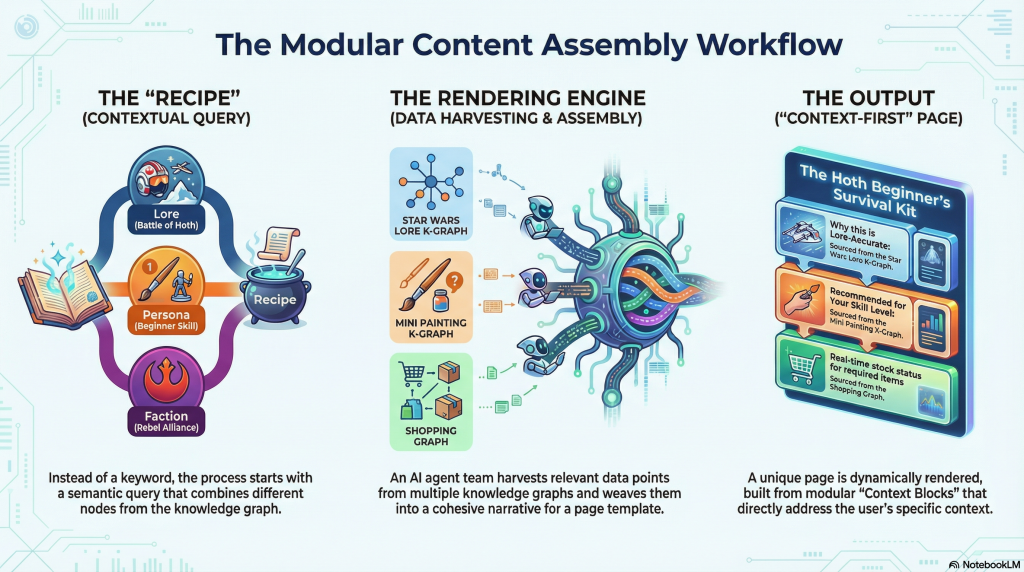
The process of building a high-gain page like “The Hoth Beginner’s Survival Kit” is triggered not by a writer opening a blank Word document, but by an SEO identifying a high-intent “Contextual Intersection.”
- Step A: The Contextual Query (The “Recipe”): Instead of a keyword like “Rebel models,” the “Recipe” for the page is a semantic query sent to the Unified Knowledge Graph. It looks for the intersection of three specific nodes:
- Node 1 (Lore): [Battle of Hoth]
- Node 2 (Persona): [Beginner Skill Level]
- Node 3 (Faction): [Rebel Alliance]
- Step B: Data Harvesting (The Agents): The Agentic Team performs the “harvest”:
- The Legion Strategist identifies the Rebel Commandos and Tauntaun Riders because they have high “Hoth Lore” scores and low “Complexity” scores in the Star Wars: Legion KGraph.
- The Painting Coach pulls the “Snow and Ice Effects” guide from the Mini Painting KGraph.
- The In-Store Quartermaster checks the Shopping Graph to ensure the “White Primer” and relevant Contrast paints are in stock.
- Step C: Dynamic Assembly (The Rendering): The website’s front-end hosts a Template with “slots” for graph data. The Coordinator Agent uses an LLM to weave these discrete facts into a cohesive narrative, populating the slots.
The Practical Implementation: The “Context Block”
Instead of writing a static 2,000-word article that quickly becomes outdated, we can develop “Context Blocks.”
On the rendered page, a block powered by the graph might look like this:
“Why this is Lore-Accurate:“
[Dynamic Data Slot: Star Wars Lore K-Graph]
“The Rebel Commandos were the primary scout force during the evacuation of Echo Base. Our graph confirms these units were present during the Blizzard Force counter-attack.“
Immediately followed by:
“Recommended for [your skill level]:“
[Dynamic Data Slot: Mini Painting KGraph]
“As a Beginner, our Painting Coach recommends the ‘Dry Brush Frost’ technique for these models. It provides a high-quality finish with only 15 minutes of work.“
The Role of Human Content Writers: Architect and Auditor
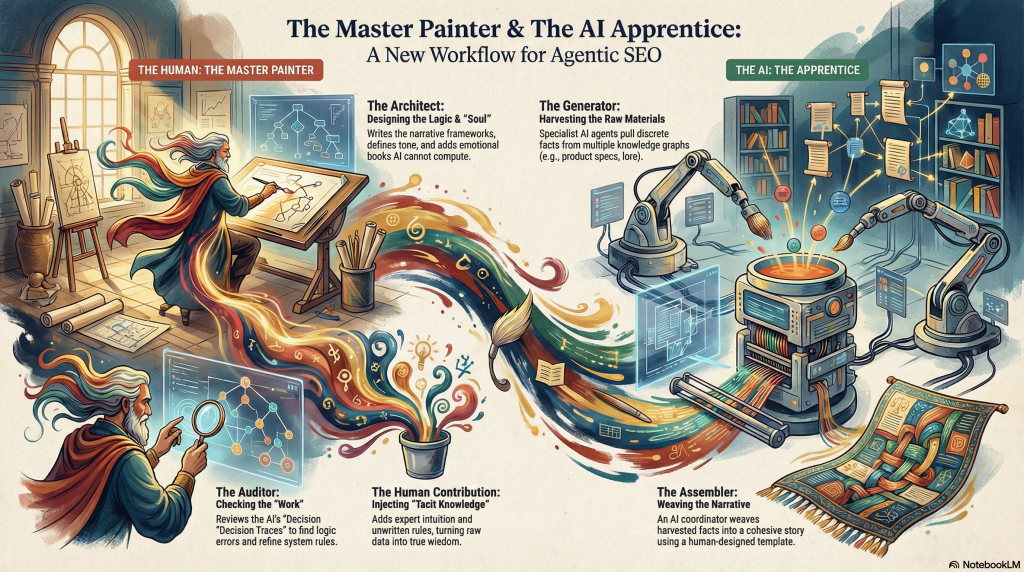
If the agents are assembling the data and the template is rendering the page, what does the human writer do? Their role shifts from “Generator” to “Architect and Auditor.”
A. Defining the “Semantic Connective Tissue”: AI is great at facts but often poor at “soul.” Human writers write the Narrative Frameworks. They decide the tone and voice of the “Hoth Survival Kit.” They write the high-level introductions and the “emotional hooks” that a Knowledge Graph cannot yet compute.
B. The “Tacit Knowledge” Injection: Knowledge Graphs store “Explicit Knowledge” (facts). Humans possess “Tacit Knowledge” (intuition):
- Explicit: “This paint is white.“
- Tacit: “This white paint is a bit chalky, so add a drop of water to make it flow better on Tauntaun fur.” The human writer’s job is to capture these “Expert Gems” and add them to the Mini Painting KGraph so the agents can use them in every future recommendation.
C. System Auditing (The SME Board): As discussed in the “AI Supervisor” section, human experts become the Audit Board. They review the “Decision Traces” to ensure the agents aren’t hallucinating lore or recommending a paint that is technically correct but practically terrible for a beginner.
D. Content Strategy as “Intersection Discovery”: Writers stop looking for keywords with high volume and start looking for Contextual Gaps. They ask: “We have a Hoth kit for beginners… do we have a Sullust kit for advanced painters? No? Okay, let’s map the Lore, Products, and Techniques needed to build that intersection.“
Why This Wins in SEO
- For Classic Search: We are creating a page with an incredibly high Information Gain score. While competitors have one “Rebel Guide,” you have dozens of “Context-First” pages (Hoth Beginner, Endor Veteran, Scarif Tactical) that provide unique, evidence-based reasoning derived from our proprietary traces.
- For Agentic Search: We are providing a calculable addressable state. When an agent asks, “What is the best way for a new player to start a Hoth army?“, our page isn’t just a candidate; it is the definitive calculation of that answer.
In this new workflow, the Human Writer is no longer the “Worker” filling the page with words; they are the “Master Painter” designing the logic that the AI uses to build the world.
By surfacing this reasoning through the significantEvidence schema, we move from claiming authority to proving it through Reasoning Lineage.
The Implementation (The “Context-First” Page Schema):
This is how you tell a crawler that a page is a synthesis of expert-led graph nodes.
{
“@context”: “https://schema.org/”,
“@type”: “WebPage”,
“name”: “The Hoth Beginner’s Survival Kit”,
“@id”: “https://minipainter.co/kits/hoth-beginner/#page”,
“about”: [
{ “@id”: “https://minipainter.co/lore/battle-of-hoth/#event” }, // Addressable Lore Event
{ “@id”: “https://minipainter.co/personas/#beginner-painter” } // Addressable Persona
],
“significantEvidence”: {
“@type”: “DataSet”,
“name”: “Aggregated Decision Traces: Hoth Collection”,
“url”: “https://minipainter.co/transparency/logs/hoth-synthesis-992/”
},
“mainEntity”: {
“@type”: “HowTo”,
“name”: “Painting Hoth Rebels”,
“isBasedOn”: { “@id”: “https://minipainter.co/archive/guides/rebel-v1/#how-to” }
}
}
The Business Case: Cost, Benefit, and Stakeholder Buy-In
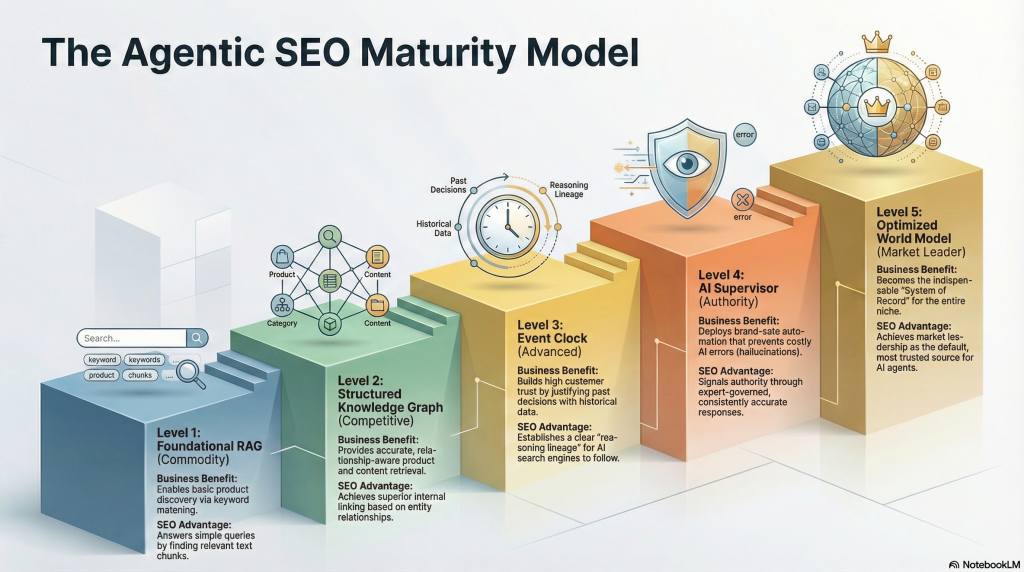
The Scientific Theory: The Capability Maturity Model (CMM) for Agentic SEO
Transitioning to a Context Graph is not a binary switch but an architectural evolution. To justify this investment to stakeholders, we must frame it through the Capability Maturity Model (CMM).
This model allows CMOs to benchmark their brand’s current AI readiness against the market leaders, moving from “Data-at-Rest” to a fully optimized world model.
In the “Reasoning Web,” our brand valuation is increasingly tied to our Organizational World Model, aka the structured representation of our unique expertise that agents can use to calculate results.
The Five Levels of Agentic Maturity
- Level 1: Foundational RAG (Commodity): The system performs simple vector searches over text chunks. It finds products by keyword match but lacks relationship logic. Risk: Total replacement by generic LLMs.
- Level 2: Structured Knowledge Graph (Competitive): The “Sentient Store” phase. The system understands the relationships between entities (e.g., Lore, Units, and Paints). Benefit: Accurate retrieval and better internal linking.
- Level 3: Bitemporal Reasoning (Advanced): Implementation of the Event Clock. The system understands when facts were true and can justify past decisions based on historical data. Benefit: High trust and lineage.
- Level 4: Supervised Agentic Execution (Authority): Brand norms are enforced by an AI Supervisor. Specialists (Strategist, Coach, Quartermaster) collaborate under expert-led constraints. Benefit: Hallucination-free, brand-safe automation.
- Level 5: Optimized World Model (Market Leader): The store autonomously simulates outcomes and optimizes its own graph structure for visibility and conversion. It becomes the “System of Record” for its niche. Benefit: Indispensable authority in the Agentic Age.
In Plain English: The “Knowledge Asset” vs. “Marketing Expense”
Most marketing efforts are expenses: you pay for an ad, the ad runs, and the value disappears once the budget is exhausted.
A Context Graph is a Capital Asset. Every time a human expert adds a “Tacit Knowledge” gem or the AI Supervisor logs a correction, the asset grows more valuable.
Instead of renting attention through ads, we are building a Reasoning Moat.
In a future where AI agents perform the initial product research, having the “most data” matters less than having the “most trustworthy logic.”
If an agent can calculate a perfect result using our graph but can only “guess” a result using our competitor’s flat text, we win the sale by default.
Actionable Recommendations for Stakeholders:
1. Frame the ROI through “Information Gain” and LTV
Explain that the Context Graph is the only way to survive “LLM Erasure,” the process where generic AI answers questions without ever citing a source.
- The Argument: Generic AI can summarize “What” we sell for free. We must own the “Why” and the “How.”
- Mini Painter Co. Example: By using the Event Clock and Decision Traces to prevent bad recommendations for beginners, we increase Customer Lifetime Value (LTV) by ensuring every new hobbyist succeeds on their first try, turning a one-time buyer into a lifelong enthusiast.
2. The Efficiency Argument: Reducing the “Latency of Sale.”
Show how the graph converts machine-led interest into revenue faster than traditional human funnels.
- The Argument: An AI agent can traverse our Seven Graphs to assemble a complex, 50-item lore-accurate shopping cart in milliseconds. A human doing the same research manually takes 45 minutes and faces a high drop-off risk.
- SEO Benefit: We are optimizing for the “Agentic Conversion Rate.”
3. Start with a “Vertical Slice” (The Pilot Project)
Don’t try to map the entire company at once. Map a single, high-margin “Contextual Intersection” to prove the tech.
- Mini Painter Co. Example. Build the “Hoth Beginner’s Kit” as a proof of concept. Map the Lore, Products, and Painting guides for just this intersection. Use the Decision Traces to prove to the board that the site is now the #1 cited source for “Hoth painting” in AI search results.
Implementation: The Business Logic Metadata
To make our business case calculable by AI agents, we must expose our full breadth of expert services.
This tells the machine that Mini Painter Co. isn’t just a shop, but it is a comprehensive Reasoning Engine for the Star Wars: Legion ecosystem.
The JSON-LD Implementation
{
“@context”: “https://schema.org/”,
“@type”: “Service”,
“@id”: “https://minipainter.co/#advisory-service”, // The main authority node
“name”: “Mini Painter Co. Agentic Advisory”,
“provider”: {
“@type”: “Organization”,
“name”: “Mini Painter Co.”
},
“serviceType”: [
“Expert-Led Painting Strategy”,
“Expert-Led Tabletop Gaming Strategy and Tactics”,
“Lore-Accurate Miniature Curation”
],
“hasOfferCatalog”: {
“@type”: “OfferCatalog”,
“name”: “Star Wars: Legion Solutions”,
“itemListElement”: [
{
“@type”: “Offer”,
“itemOffered”: {
“@type”: “Product”,
“@id”: “https://minipainter.co/products/swl-core-set/#product”,
“name”: “Star Wars: Legion Core Sets and Expansions”
}
}
]
},
“description”: “A unified reasoning engine combining bitemporal event logs, lore accuracy, and expert tactical oversight.”
}
The Strategic Outlook: Balancing Legacy and the Frontier
As I finalize this blueprint for the “Sentient Store,” it is vital to acknowledge a technical reality: Agentic search, in its full recursive form, is still in its infancy. The transition from a “Search Web” to a “Reasoning Web” is a marathon, not a sprint.
Building a Context Graph is a resource-intensive, time-consuming investment. Therefore, the strategic mandate for 2026 is not to abandon current SEO practices, but to evolve them.
The classic SEO work we do today – optimizing for search intent, building authority through high-quality editorial content and campaigns, and managing technical health – is the engine that provides the brand value, the topical authority, and the financial capital necessary to fund the blueprint of the future.
However, we cannot wait for the technology to mature before we begin.
If we cede this ground now, we risk losing the natural leadership of this field to “AI Bros”, who may understand the models but lack the deep understanding of entity relationships, user intent, and information architecture that defines the SEO profession.
The Multi-Dimensional Advantage of the Context Graph
Why should stakeholders invest now, and why should SEOs push for this evolution today? The advantages span the entire business ecosystem:
1. The SEO Advantage (Classic & AI Search)
- Classic SEO: Implementing a Context Graph forces a level of structured data precision that drastically improves parsing efficiency and entity disambiguation. This correlates to higher rankings in traditional SERPs through superior relevance.
- AI Search: By providing “Significant Evidence” and “Decision Traces,” we satisfy the Information Gain requirements of AI agents. We move from being “one of many” results to being the authoritative citation used by AI Overviews to calculate answers.
2. The Brand Resonance Advantage
- Trust through Transparency: When a brand shows its “work” through an AI Supervisor and Event Clock, it builds a level of trust that generic content cannot match.
- Consistency of Voice: The Lexical and Brand Graphs ensure that whether a customer interacts with a blog post, a support bot, or an autonomous agent, the brand’s unique lore, expertise, and “soul” remain constant.
3. The Business & Financial Advantage
- Reduced Latency to Conversion: By enabling “Modular Content Assembly,” we reduce the time it takes for a customer to go from a complex problem (e.g., “I need a lore-accurate Hoth army”) to a completed purchase.
- Future-Proofing the Asset: Unlike paid channels, a Context Graph is an appreciating capital asset. Every expert rule added today increases the “Organizational Intelligence” of the company, raising its long-term valuation in a machine-led economy.
The Final Directive: SEO as the Architect of the Reasoning Web
The “AI Bros” see the models as the destination; we see them as the processors.
The real power lies in the Data Layer.
SEOs have always been the bridge between human intent and machine understanding. By embracing the Context Graph, we aren’t just “doing SEO”; we are designing the logic that the AI will use to build the future of commerce.
Let’s start building our “Vertical Slices” today. The evolution is closer than it appears, and the leadership of the Reasoning Web belongs to those who structure the world’s knowledge.
Useful sources
As the medieval philosopher Bernard of Chartres once said: “We are like dwarves sitting on the shoulders of giants.”
I would not have been able to think and elaborate this long-form article without reading, studying, and pondering these excellent sources, which I recommend you save, read, and study as well:
- AI’s trillion-dollar opportunity: Context graphs by Joanne Chen, Jaya Gupta.
- Context Engineering: Connecting the Dots with Graphs by Stephen Chin, Neo4j.
- Context Graphs in the Real World: Company Culture as Critical Context for AI Agents by Tatyana Mamut.
- Context Graphs (Amigo documentation).
- Context Graphs: What the Ontology Debate Gets Wrong by Kirk Marple.
- Context is the next data platform—and why context graphs are key to understanding processes by Arvind Jain.
- How do you build a context graph by Java Gupta.
- How to build a context graph by Animesh Koratana.
- In the Age of AI and Context Graphs, Intellectual Honesty Is a Leadership Responsibility by Kassidy Bird.
- Reasoning Over Memory, Not Retrieval by Andrea Volpini.
- Recursive Language Models by Arjun.
- The Context Graph Manifesto by Daniel Davis.
- The Context Layer AI Agents Actually Need by Kirk Marple.
- The No BS Guide to Build a Context Graph by Najmuzzaman Mohammad.
- The Reasoning Web by Andrea Volpini.
- Context Graphs: The missing link for a truly Agentic Enterprise by Arun S.
- Why “Context Graphs” Make Datagraphs Strategically Vital by Venkat Venkatraman.
- GraphSearch: An Agentic Deep Searching Workflow for Graph Retrieval-Augmented Generation by Cehao Yang, Xiaojun Wu, Xueyuan Lin, Chengjin Xu, Xuhui Jiang, Yuanliang Sun, Jia Li, Hui Xiong, and Jian Guo.
Technical Addendum: Implementing Google Universal Commerce Protocol (UCP) for the Sentient Store
Just a couple of hours after I published this guide, Google announced the Universal Commerce Protocol on Google and published the following UCP implementation guide.
Obviously, I could not wait and decided to add this technical addendum, because, as you will see below, the UCP model is the “missing link” that transforms the Sentient Store from a sophisticated reasoning engine into a fully autonomous transactional powerhouse.
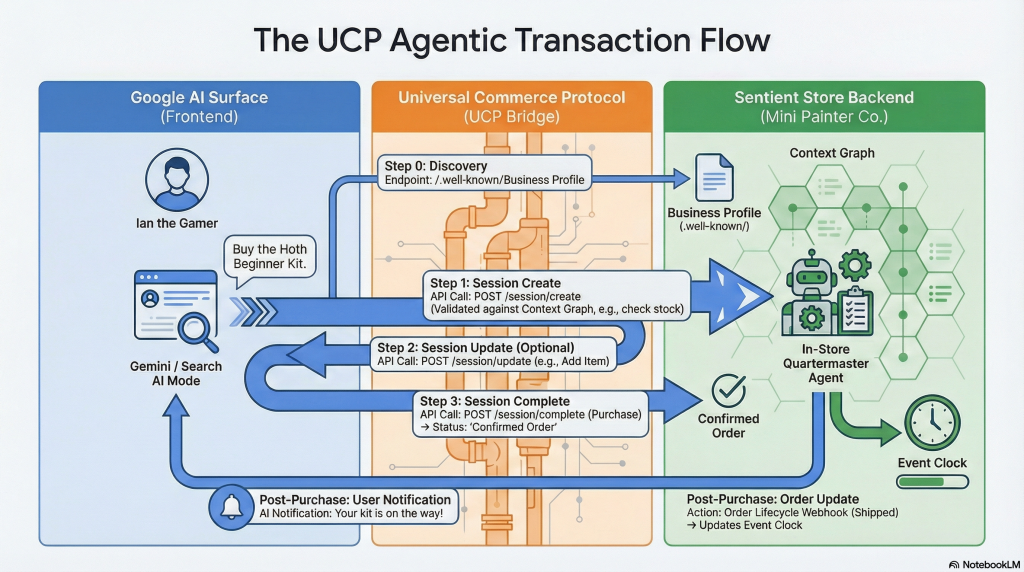
The Universal Commerce Protocol (UCP) is a new open standard designed to turn AI interactions into instant, frictionless sales. By integrating UCP with our Context Graph, we enable “Ian the Gamer” to buy a Hoth-themed paint set directly within Google AI Mode in Search or Gemini without leaving the conversation.
The following steps outline how the Mini Painter Co. technical team (led by the In-Store Quartermaster) implements this agentic transactional layer.
The Business Profile: Defining Capabilities
Before transactions can occur, we must publish a Business Profile. This allows Google to discover our payment handlers and negotiate “capabilities” (like lore-based bundling or specialized shipping).
Actionable Step: We will host a JSON file at our .well-known directory that maps to our Brand Knowledge Graph.
{
“@context”: “https://schema.org/”,
“@type”: “Service”,
“@id”: “https://minipainter.co/#ucp-profile”,
“name”: “Mini Painter Co. UCP Interface”,
“capability”: [“native_checkout”, “guest_checkout”, “account_linking”],
“payment_handler”: “https://minipainter.co/api/ucp/pay”,
“public_key”: “YOUR_VERIFICATION_KEY”
}
Strategic Note: This profile acts as the handshake between our Brand Knowledge Graph and Google’s AI, verifying our identity and supported services.
The Native Checkout Flow (The Quartermaster’s Endpoints)
To enable agentic commerce, we must implement three core REST endpoints. These endpoints allow the Quartermaster to receive data from the Strategist and Coach and turn it into a valid order.
A. Session Creation (/session/create)
When Gemini says, “I’ve added the Rebel Commando paint kit to your cart,” it calls this endpoint.
Code Sample (Python/Flask Example):
@app.route(‘/api/ucp/session/create’, methods=[‘POST’])
def create_session():
# Context Graph Logic: Validate that the Hoth Kit matches ‘Beginner’ status
user_context = request.json.get(‘context’)
items = request.json.get(‘items’)
# Session initialization for UCP
return jsonify({
“session_id”: “8892-hoth-session”,
“total”: {“amount”: “45.00”, “currency”: “USD”},
“items”: items,
“capabilities_required”: [“shipping_address”, “payment_token”]
})
B. Session Update (/session/update)
If the user says, “Wait, I need two sets of Tauntaun fur white,” the AI Mode calls this to update the logic. This allows for multi-item carts, a core feature of the UCP roadmap.
C. Session Completion (/session/complete)
This is the final “Buy” action. UCP creates a transparent accountability trail between Mini Painter Co., the payment provider, and Google.
Identity and the “Persona-Entity Bridge”
UCP supports two paths: Guest Checkout (default) or Account-Linked Checkout.
Practical Example: By implementing OAuth 2.0 account linking, Mini Painter Co. can sync Ian’s profile. When he enters AI Mode, UCP recognizes his Persona Entity (mpco:persona/ian-the-gamer), automatically applying his “Beginner” skill-level norms to the checkout logic.
The Event Clock: Pushing Order Lifecycle Updates
UCP is not just about the sale; it covers the Order Lifecycle. You must call Google’s webhooks to push order updates.
Actionable Step: When the physical paint set leaves the warehouse, the Quartermaster triggers a webhook. This logs a new event in our Event Clock, which Google’s AI can then report back to the user: “Ian, your Hoth Survival Kit has shipped and will arrive on Tuesday.“
Summary of UCP Integration Benefits
Agentic Readiness: You are now ready for direct purchases within the interaction flow, reducing friction and cart abandonment.
Protocol Compatibility: UCP is fully compatible with Model Context Protocol (MCP) and Agent2Agent (A2A).
Merchant Control: You remain the Merchant of Record, retaining full ownership of customer data and the post-purchase relationship.
