

Table of Contents
The Enunciation of Intelligence in the Age of Synthesis
Every digital interface carries rhetorical weight. Pixels, interaction patterns, and transition animations function as signifiers within a semiotic system designed to communicate the system’s utility, authority, and intelligence.
For two decades, the dominant metaphor of the internet was the index. Search engines like Google functioned as vast, dynamic card catalogs, their interfaces governed by the semiotics of pointing. The “blue link” was the fundamental unit of this era, an indexical sign that promised meaning existed elsewhere.
We are now observing a gradual but definitive shift from an indexical paradigm to a synthetic paradigm.
Generative AI search interfaces – Claude, ChatGPT, Perplexity, Google Gemini, and the trifurcated Google experience of AI Overviews, Web Guide, and AI Mode – represent the definitive protagonism of “Answer Engines.”
In this paradigm, the interface does not merely point to external truths; it generates meaning internally. It synthesizes vast corpora of data into a singular, conversational narrative, mediating the user’s relationship with knowledge through the simulation of a dialogue.
In this article, I will provide a semiotic analysis of this paradigm shift, building on the Search Journey framework and interpreting the current landscape through the lens of Umberto Eco’s semiotic theory and Gérard Genette’s concept of paratext. I will show you through the semiotics lens that while traditional search functioned as an “Open Work” (inviting the user to choose their path), AI search often functions as a “Closed Text” (dictating a synthesized reality), creating a tension that each interface attempts to resolve through distinct design affordances.
Theoretical Framework: The Semiotics of the AI Search “Messy Middle”
To analyze the interface, we must first establish the semiotic rules that govern the user’s interaction with information. This analysis integrates the Search Journey framework with Umberto Eco’s theories of interpretation and additional semiotic frameworks that prove essential for understanding AI-mediated search.
The Search Journey as Semiotic Loop
The search process is a semiotic loop consisting of four critical phases, and the new AI interfaces are radically reconfiguring these phases:
- The Trigger (The Spark): The moment meaning sparks in the user’s mind. In the generative era, the interface encourages the user to express this trigger in natural language, bypassing the need to translate “human need” into “machine keywords.”
- Exploration (Meaning in Motion): The process of expanding the “encyclopedia” of the self. Traditional search supported this through divergence (known with the classic and “stereotyped” 10 blue links denomination). AI interfaces now attempt to synthesize exploration, keeping the user inside the “walled garden” of the chat (e.g., Google AI Mode’s “Query Fan-Out”).
- Evaluation (Weighing the Signs): The site of the greatest semiotic conflict. In a SERP, the user evaluates the authority of a source (e.g., Reddit vs. Wikipedia). In an AI answer, the AI acts as the evaluator, presenting a “short answer” that implies the evaluation has already been done.
- Experience (The Final Interpretant): The semiotic closure where meaning stabilizes. Increasingly, the “Experience” happens on the interface via a synthesized summary (Zero-Click), rather than on a destination website.
Umberto Eco’s “Model Reader” in the Algorithmic Age
Umberto Eco argued that every text constructs a “Model Reader”, an ideal recipient capable of cooperating with the text to generate its meaning.
- Open vs. Closed Texts: Eco distinguished between “closed texts” (dictating a specific interpretation) and “open texts” (inviting multiple interpretations). Traditional Google Search results were structurally “open,” aka a field of possibilities. AI answers often function as “closed texts,” reducing the polyphony of the web to a single, authoritative monologue. Google AI Mode and the LLMs in general attempt to simulate openness within a closed system.
Genette’s Paratext: The Frame That Shapes Meaning
Gérard Genette introduced the concept of paratext, the elements surrounding a text that shape how we interpret it (titles, prefaces, footnotes, cover design). In AI search interfaces, paratext becomes crucial:
- Citation Panels: The sources sidebar in Perplexity, Claude, and ChatGPT functions as paratext. It is not the main text, but it shapes how we interpret the main text’s authority. It says: “This synthesis has roots.”
- Commercial Metadata: In Google AI Mode, prices and star ratings are paratextual authority markers. They transform the answer from “information” into “recommendation with commercial grounding.”
- The “Thinking” Disclosure: Gemini’s “Show Thinking” toggle is a paratextual device that transforms the answer from “oracle pronouncement” into “reasoned conclusion.”
The “Implied Author” vs. “Narrator” Distinction
Literary theory distinguishes between the implied author (the persona constructed by the text as its creator) and the narrator (the voice delivering the content). This distinction proves essential for understanding AI search:
- LLMs without citations: The AI is both narrator and implied author. It appears to have created the knowledge it delivers.
- LLMs with web search: The footnotes create distance; the narrator is presenting someone else’s work. The implied author becomes “curator” rather than “creator.”
- Google Web Guide: The implied author is “organizer”; neither creating new content nor merely pointing to it, but structuring existing content into navigable categories.
The Zero-Click Paradox: Reframing Success and Failure
The concept of “zero-click” search requires semiotic reframing in the AI era.
In traditional search, a zero-click result (the user doesn’t click any link) was often interpreted as failure, where the user either found nothing useful or abandoned the search. In AI search, zero-click is repositioned as success, where the user got what they needed without needing to go elsewhere.
This creates a fundamental semiotic tension: the same user behavior now carries opposite semiotic weight depending on whose perspective you adopt:
- User perspective: Zero-click = efficiency, task completion
- Publisher perspective: Zero-click = traffic loss, value extraction
- Platform perspective (Google/LLMs): Zero-click = engagement success, user retained in ecosystem
Each AI interface navigates this tension differently, and their design choices reveal which stakeholder’s interpretation they privilege.
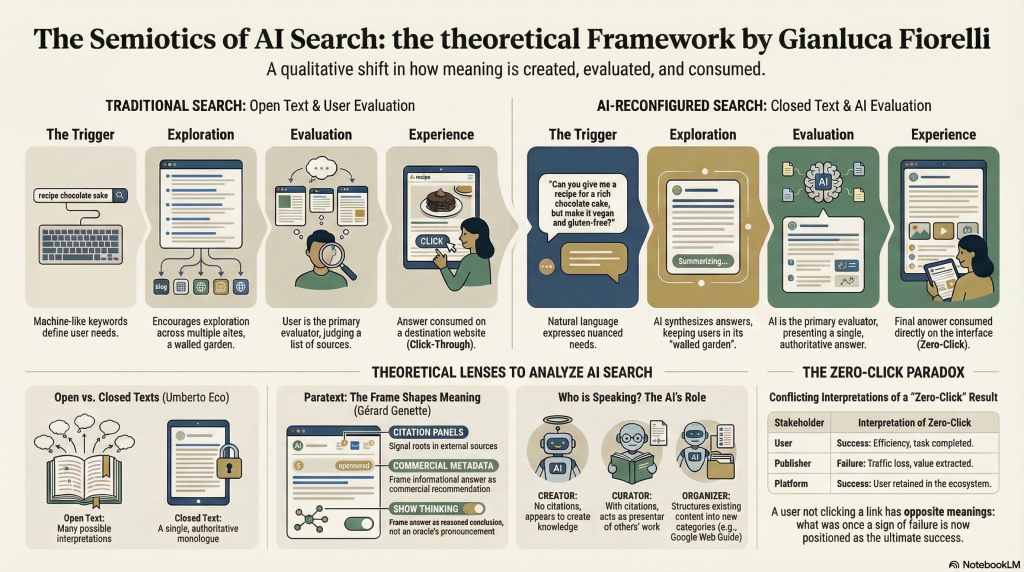
Click to view and download the infographic of “Theoretical Framework: The Semiotics of the AI Search ‘Messy Middle‘”
Case Study 1: Claude or the Dual-Nature Oracle
Dominant Semiotic Mode: Adaptive Authority (Experience Phase with Optional Exploration)
The Claude interface presents a fascinating semiotic duality.
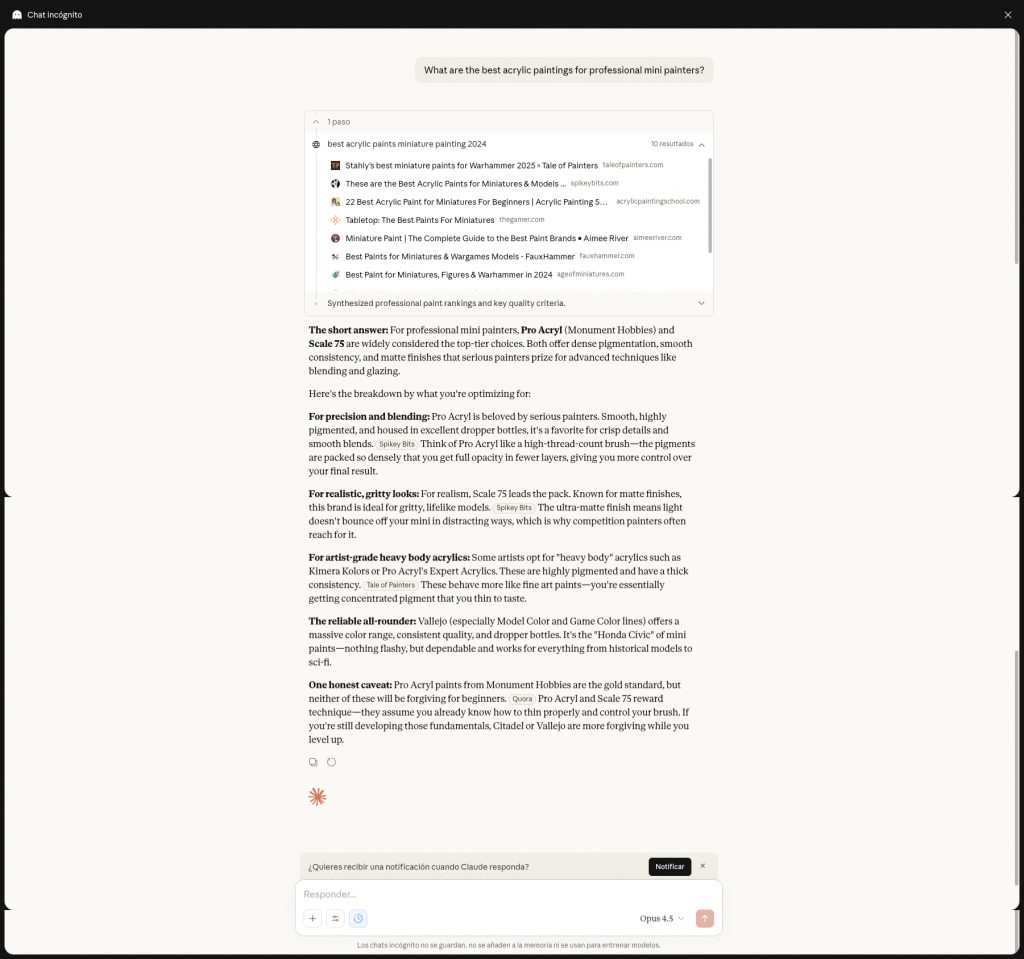
Unlike other AI search tools that commit to a single identity, Claude can allow to operate in two distinct modes: the “hermetic oracle” (without web search) and the “grounded synthesizer” (with web search enabled). The screenshot under analysis shows Claude with web search enabled, revealing a semiotic profile more complex than simple minimalism.
Visual Semiotics: The Architecture of Grounded Synthesis
The interface displays several key visual elements that construct meaning:
- The “1 paso” (1 step) Indicator: At the top of the response, a collapsible panel shows the search query (“best acrylic paints miniature painting 2024”) and “10 resultados” (10 results). This is a transparency signifier; Claude is showing its work, revealing the grounding process that underlies the synthesis.
- The Source List: Visible sources include taleofpainters.com, spikeybits.com, acrylicpaintingschool.com, thegamer.com, aimeeriver.com, fauxhammer.com, and ageofminiatures.com. These function as epistemic anchors, and the synthesis is tethered to specific, verifiable locations on the web.
- Inline Citations: Throughout the response, small citation markers (“Spikey Bits”, “Tale of Painters”, “Quora”) appear inline. Unlike Perplexity’s superscript numbers, Claude uses named citations, signifying that these are communities and voices, not just reference numbers.
- Generous White Space: Despite the citations, the interface retains significant negative space. This creates a semiotic balance: grounded but not cluttered, authoritative but not overwhelming.
Written Semiotics: The Rhetoric of Conversational Expertise
- The “Short Answer” Opening: The response begins with “The short answer: For professional mini painters, Pro Acryl (Monument Hobbies) and Scale 75 are widely considered the top-tier choices.” This rhetorical move acknowledges that the reader may want different depths of information, signifying respect for user agency.
- Categorical Organization with Rationale: The breakdown (“For precision and blending,” “For realistic, gritty looks,” “For artist-grade heavy body acrylics,” “The reliable all-rounder“) goes beyond mere categorization. In other words, each category includes why a professional might choose it, constructing a Model Reader who is thoughtful about their specific needs.
- The Analogy as Trust Signal: Claude uses an analogy: “Think of Pro Acryl like a high-thread-count brush” and calls Vallejo “the ‘Honda Civic’ of mini paints.” These aren’t just explanations; they’re semiotic bridges connecting specialized knowledge to everyday understanding, signaling that the author understands the reader’s frame of reference.
- The “Honest Caveat”: The response concludes with “One honest caveat: Pro Acryl paints from Monument Hobbies are the gold standard, but neither of these will be forgiving for beginners.” This is performative honesty; by acknowledging limitations, Claude constructs itself as a trustworthy advisor rather than a sales pitch.
The Dual-Mode Semiotic: Oracle vs. Researcher
Claude’s ability to operate with or without web search creates a unique semiotic proposition:
- Without Web Search (“Oracle Mode”): Claude draws entirely from training data. The interface is pure minimalism: text on white space. The implied author is an all-knowing entity that already contains the world’s knowledge. This is the “Closed Text” at its most extreme.
- With Web Search (“Researcher Mode”): Claude reveals its sources, shows its search process, and attributes claims. The implied author shifts from “oracle” to “curator.” The text becomes more “open”, and the user can verify, explore the sources, and disagree with the synthesis.
This duality is a strategic semiotic choice. It allows Claude to serve both users who want quick, authoritative answers (Oracle Mode) and users who need verifiable, traceable information (Researcher Mode). The user’s choice of mode becomes part of the semiotic contract.
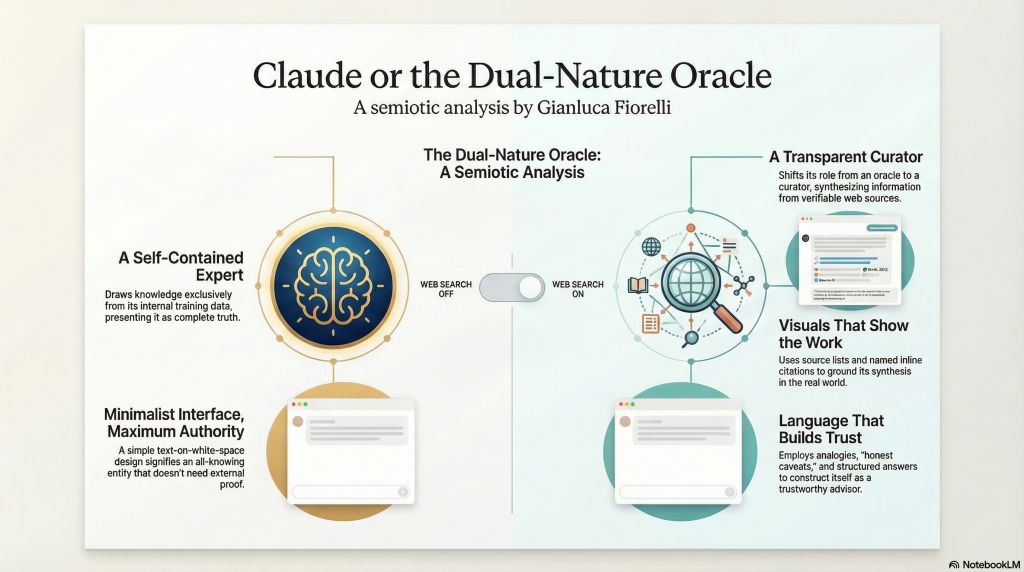
Click to download the infographic “Claude or the Dual-Nature Oracle“.
Case Study 2: ChatGPT or the Visual Hybrid
Dominant Semiotic Mode: Synthesized Exploration
The ChatGPT interface integrates visual elements into the conversational flow, representing a “multimodal” semiotic strategy.
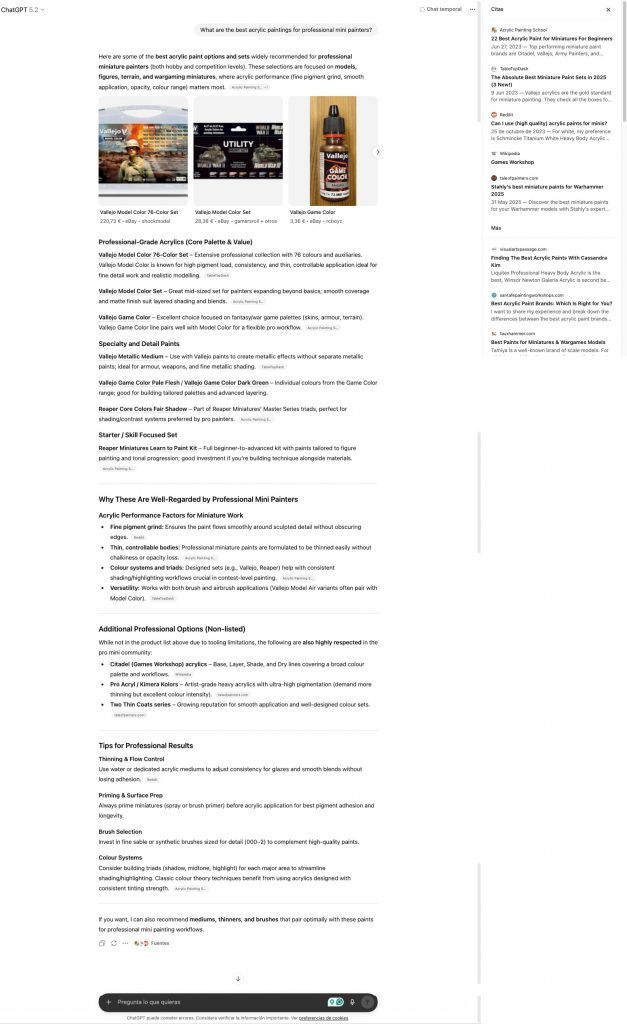
The Visual Shelf: Simulation of Retail
ChatGPT presents a row of product images (Vallejo sets) at the top.
- Standardization of the Image: By standardizing the product shots, the AI creates a virtual shelf. It transforms the chaotic marketplace of the web into a curated boutique.
- The Carousel as Synecdoche: These images stand in for the entire category. The visual prominence of the Vallejo bottle anchors the user’s mental image of “professional paint” to this specific brand before the text is even read.
The Textual Structure: The Listicle 2.0
- The Semiotics of Efficiency: Bold headers and bullet points signify efficiency. It constructs the Model Reader as an “information processor.”
- The “Cites” Sidebar: ChatGPT displays citations in a sidebar (Acrylic Painting School, Spikey Bits). This acts as a structural apology. It says, “I am not making this up.” However, by relegating sources to the margin, the interface maintains the primacy of the synthesized answer.
The sidebar functions as Genettian paratext; present but peripheral, shaping interpretation without dominating the reading experience.
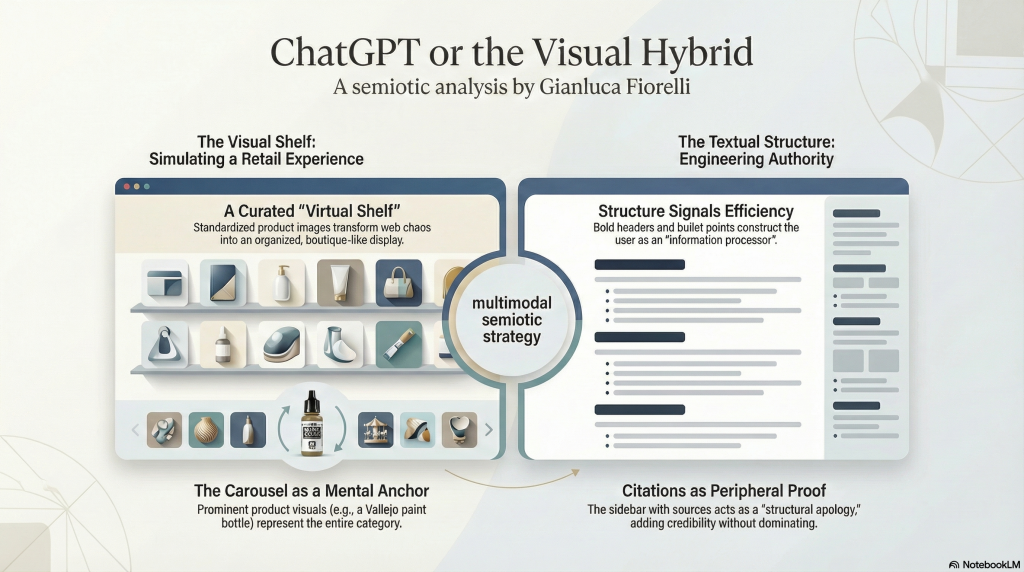
Click to download the infographic “ChatGPT or the Visual Hybrid“.
Case Study 3: Perplexity or the Academic Simulacrum
Dominant Semiotic Mode: The Evaluation Phase
Perplexity positions itself semiotically as a “Research Assistant” or “Answer Engine.” It targets the Evaluation phase, where trust is the primary currency.
The Footnote as Trust Signal
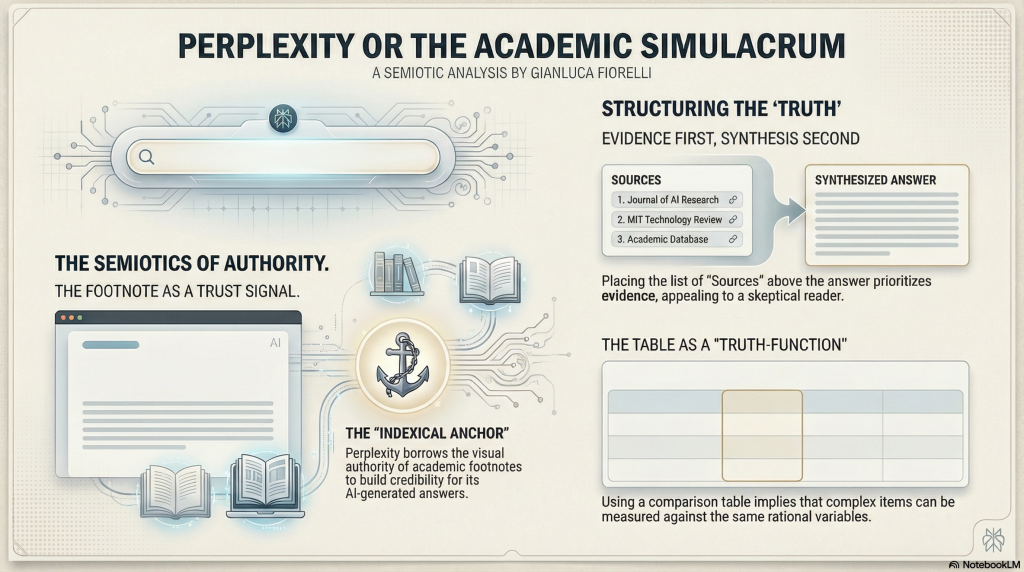
The defining visual feature is the inline citation, aka the small, superscript texts and numbers.
- The Indexical Anchor: In semiotics, an index implies a direct connection. The inline citation typical of Perplexity (but also of ChatGPT, when Gemini – instead – uses the classic 🔗 icon) is a digital index claiming: “This sentence is not a hallucination; it is tethered to a real document.“
- The “Follow-Up” Questions as Footnotes: The “follow-up” questions are a distinctive feature of Perplexity. The other LLMs also try to nudge the users to continue the conversation, making questions at the end of the answer, but Perplexity, by adopting the semiotic codes of academia (footnotes), attempts to transfer the prestige of the scientific method to the AI generation process.
The “Sources” Row
- Primacy of Evidence: Placing sources before the answer creates a hierarchy: “Evidence first, synthesis second.” This appeals to a Model Reader who identifies as a “Skeptic.”
- The Table as Truth-Function: Perplexity generates a “Key characteristics table.” A table – and more in a synthetic answer – implies commensurability. In my example, it implies that “Pro Acryl” and “Vallejo” can be measured against the same rational variables.
Download the infographic of “Perplexity or the Academic Symulacrum“.
Case Study 4: Gemini or the Collaborative Reasoner
Dominant Semiotic Mode: The Trigger & Experience Loop
Gemini’s interface is defined by the semiotics of Magic and Transparent Reasoning. It bridges the gap between Trigger and Experience.
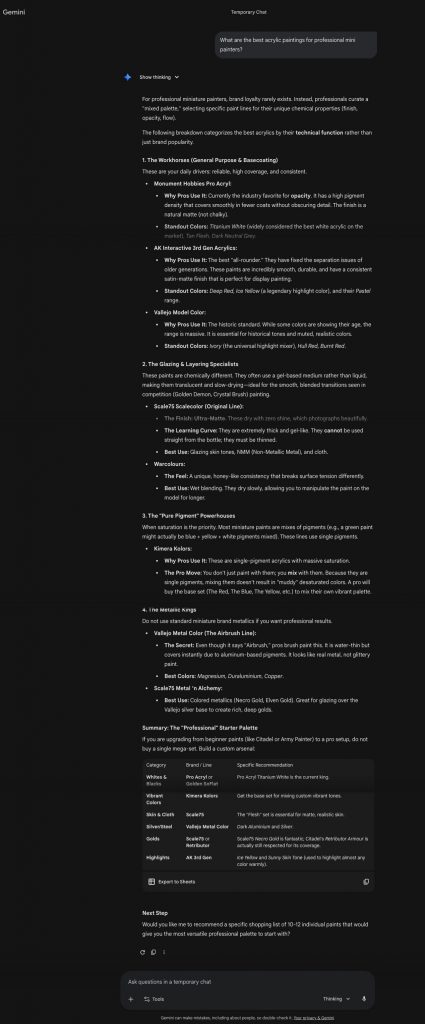
The Semiotics of the “Sparkle” (✨)
The “Sparkle” icon is the central signifier.
- Symbolism of Emergence: The Sparkle represents the emergence of something created from nothing. It frames the answer as a magical gift (“I generated this for you“) rather than a retrieved object (“I found this for you“).
- Sanctification of Synthesis: When Gemini categorizes paints into “Workhorses” and “Specialists,” the Sparkle implies this categorization is a novel insight, masking the fact that it is a probabilistic synthesis of scraped Reddit threads.
“Show Thinking”: The Theater of Transparency
- Performative Vulnerability: By default, AI is a “Black Box.” The “Show Thinking” toggle is a semiotic act of opening the box. It performs vulnerability (“Look, here is my rough work“).
- The Return of the Maze: It constructs an “Active Model Reader” who is invited to verify the logic, not just consume the output.
The thinking disclosure is the ultimate paratextual device; it doesn’t change the main text, but it fundamentally transforms how we evaluate it.
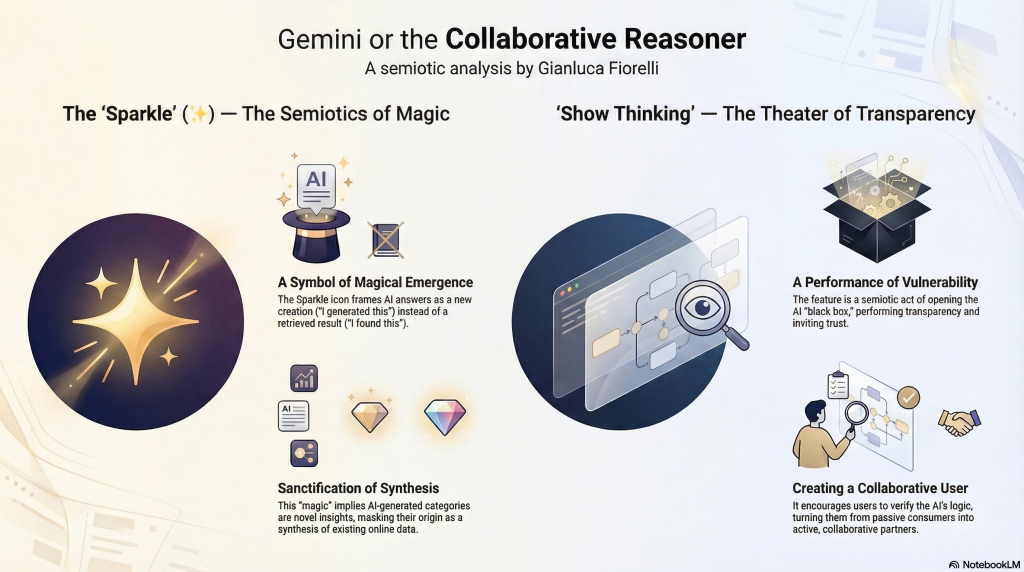
Click to download the infographic “Gemini or the Collaborative Reasoner“.
Case Study 5: Google Overviews or the Interruption
Dominant Semiotic Mode: The Short-Circuit (Skipping Exploration)
The AI Overview (AIO) for “What is mini painting?” shows a semiotically distinct object from AI Mode and LLMs’ answers. It is an interruption in the standard SERP.
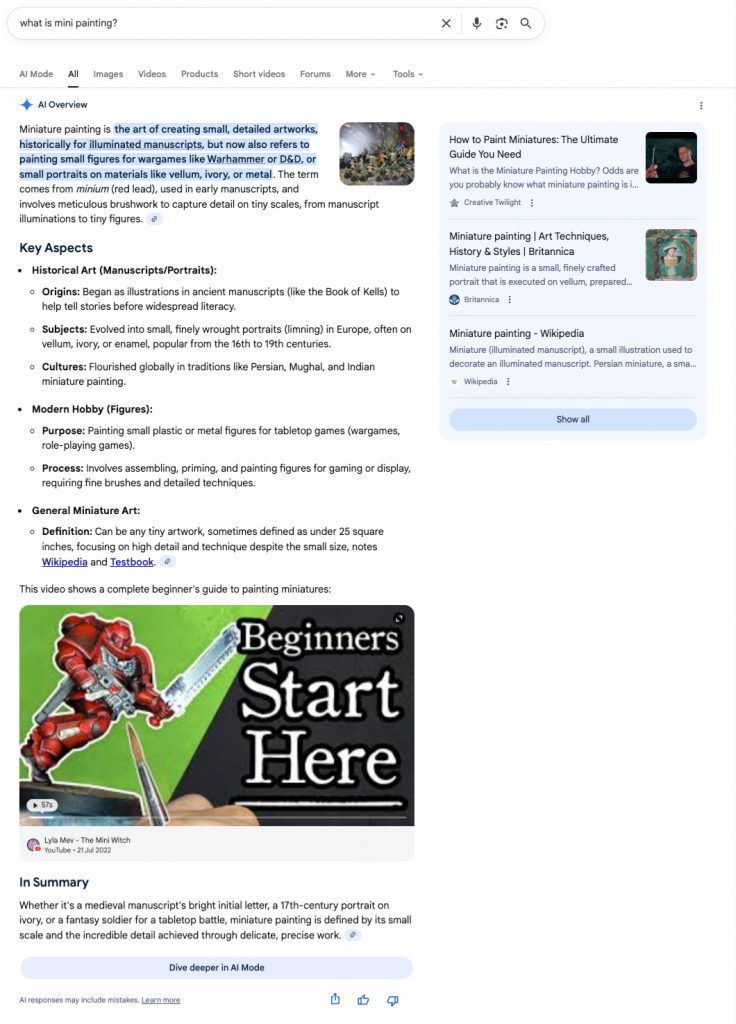
The “Penthouse” Semiotics
- Position is Power: The AIO occupies the top third of the screen (“The Penthouse”). Semiotically, this signals that the AI synthesis is the primary truth, pushing organic results “below the fold” (or close to it) into a secondary, supporting role.
- The “Closed Text” in an Open Field: The AIO attempts to be a “Closed Text” (a summary) within the “Open Text” of the SERP. It creates a semiotic barrier. If the summary satisfies the user’s Trigger, the Exploration phase is short-circuited. The user never leaves Google.
The “Snapshot” Esthetic
- Static vs. Fluid: Unlike the streaming text of Claude or the conversational flow of AI Mode, AI Overviews appears as a static block. It uses the visual language of a “Featured Snippet on Steroids”: headers, lists, and a collage of images. It is designed for glanceability, not immersion.
Case Study 6: Google Web Guide or the Organized Encyclopedia
Dominant Semiotic Mode: Structured Exploration (The Evaluation-Exploration Bridge)
The Google Web Guide represents a semiotic middle ground that has received insufficient attention until recently. It is neither the summary-first approach of AI Overviews nor the immersive destination of AI Mode. Instead, it functions as an organizational layer imposed on traditional search results.
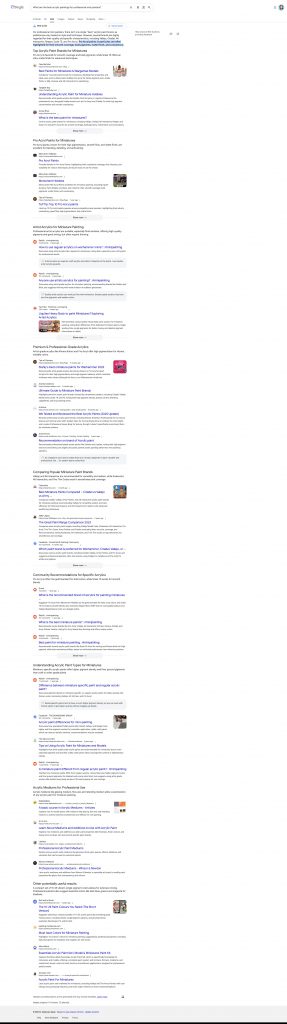
Click here to view a larger version of the Web Guide SERP screenshot.
The “Semantic Shelf” Structure
The screenshot reveals a distinctive organizational pattern:
- Category Headers as Wayfinding: Results are grouped under semantic headers like “Pro Acryl: Professional Mini Painter’s Choice,” “Artist-Quality Acrylics for Miniatures,” and “Comprehensive Paint Guides and Reviews.” These headers transform a flat list into a navigable taxonomy.
- The AI Summary Block: At the top, a “Web Guide” panel provides a brief synthesis, but crucially, the blue links remain the primary content below. The synthesis frames the exploration rather than replacing it.
- “Show more” Expandability: Each category includes “Show more” toggles, signifying that the visible results are a curated subset, not the totality. The user retains agency to expand any category.
The Implied Author as “Librarian”
Web Guide constructs a fundamentally different implied author than other AI search modes:
- Not Creator: Unlike Claude or ChatGPT, Web Guide doesn’t generate new prose. It curates and organizes existing content.
- Not Just Pointer: Unlike traditional SERP, it doesn’t merely list results by relevance score. It imposes semantic structure.
- The “Librarian” Metaphor: The implied author is a librarian who has organized the stacks, created subject headings, and prepared a brief orientation, but ultimately lets you browse the books yourself.
Semiotic Implications for the Search Journey
- Exploration is Preserved but Guided: Unlike AI Overviews (which short-circuit exploration) or AI Mode (which internalizes exploration), Web Guide maintains external exploration as the primary mode, but scaffolds it with AI-generated structure.
- The Zero-Click Tension is Reduced: Because blue links remain prominent, Web Guide doesn’t fully extract value from publishers. It’s a compromise position; AI-enhanced but not AI-dominated.
- For SEO: Category Presence Matters: Being included in the right category becomes a new optimization target. A page about “Pro Acryl” that appears under “Comprehensive Paint Guides” may receive less qualified traffic than one appearing under “Pro Acryl: Professional Mini Painter’s Choice.”
Case Study 7: AI Mode or the Immersive Destination
Dominant Semiotic Mode: The Integrated Loop (Trigger → Experience → Trigger)
Google AI Mode represents a fundamentally different semiotic object than both the AI Overviews and Web Guide. It is not an interruption or an organizational layer; it is a destination (and that is also why Google pushes so hard for its users to end their search on AI Mode).
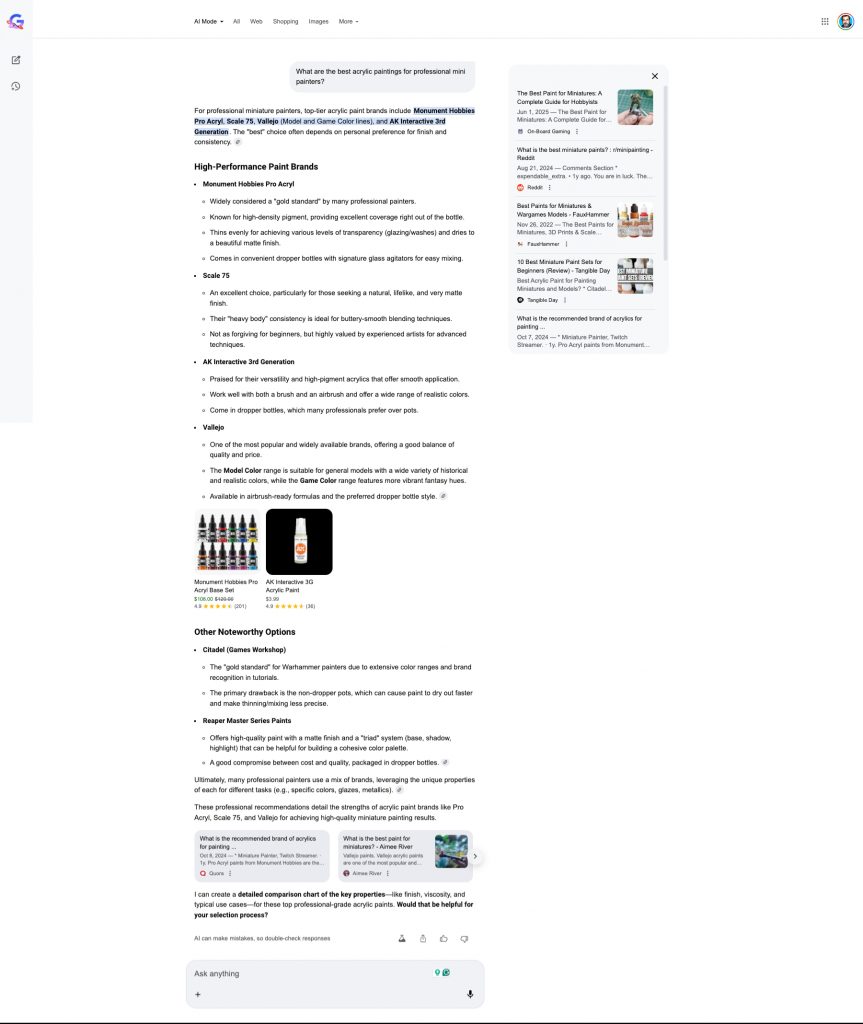
The “Immersive Tab” Metaphor
AI Mode functions as a separate “tab” or “immersive interface” that replaces the “10 blue links entirely”.
- The Conversational Container: The interface shows a chat-like history (“What are the best…“). This signals a shift from “Search” (query-response) to “Dialogue” (turn-taking). The interface retains context, allowing the Exploration phase to happen inside the chat (and this is the true function of the Query Fan-Out).
- The “Agentic” Shift: Unlike AIO, which just summarizes, AI Mode is described as doing things (planning, comparing). The interface reflects this with commercial integration.
The Commercial Semiotic: The Shopping Graph Integration
AI Mode integrates commercial data directly into the answer.
- The Collapse of the Funnel: We see “Price Tags” ($100.00), “Star Ratings” (4.8 stars), and “Product Thumbnails” woven into the text.
- Semiotic Implication: In a traditional SERP, “Information” (Wikipedia) and “Commerce” (Amazon) are visually distinct (blue links vs. Shopping ads/Merchant features). In AI Mode, they are merged. The “Best Paint” is inextricably linked to its price and rating. The AI acts as a Personal Shopper, validating the “Shopping Graph” as a source of truth equal to the “Knowledge Graph.”
“Query Fan-Out”: The Invisible Logic
“Query Fan-Out” refers to the AI breaking a complex question into sub-parts.
- Visual Manifestation: This is visible in the structured breakdown: “For precision,” “For realistic looks,” “The reliable all-rounder.” The AI has likely “fanned out” to search for precision paints, realistic paints, and beginner paints separately, then synthesized them.
- The “Agent” Semiotic: This constructs the AI not just as a reader, but as a worker doing labor on your behalf.
Download the infographic with the semiotic analysis of AI Overviews, Google Web Guide, and AI Mode
Comparative Semiotics: Summary Matrix
| Feature | AI Overviews | Web Guide | AI Mode | ChatGPT | Perplexity | Claude (w/ Search |
|---|---|---|---|---|---|---|
| Core Metaphor | The "Sticky Note" Summary | The "Organized Library" | The "Personal Consultant" | The "Visual Hybrid" | The "Research Assistant" | The "Expert Curator" |
| Spatial Logic | Interruption: Sits atop list | Organization: Structures the list | Destination: Replaces list | Multimodal: Images + Text + Sidebar | Academic: Text + Footnotes | Conversational: Text + Source Panel |
| Search Journey | Short-Circuit: Stops clicking | Guided Exploration: Scaffolds choices | Loop: Internal exploration | Synthesized Exploration | Evaluation: Encourages verification | Experience: Delivers + enables verification |
| Implied Author | Summarizer | Librarian | Personal Shopper | Information Curator | Academic Researcher | Expert Advisor |
| Commerciality | Low/Informational | Low/Links preserved | High: Info + shopping merged | Medium/Visual product focus | Low/Citations focus | Low/Named citations |
| Model Reader | The Glancer: Wants gist fast | The Browser: Wants organized options | The Shopper: Wants plan/list | The Processor: Wants efficient info | The Skeptic: Wants proof | The Expert: Wants nuance + sources |
Actionable Insights: The SEO Playbook for AI Search
The analysis of these AI interfaces reveals specific optimization strategies for the new search paradigm.
Optimize for “Query Fan-Out” (The Cluster Strategy)
AI Mode breaks complex queries (e.g., “Best paints for minis”) into sub-intents (Precision, Realism, Beginners).
- Action: Do not just write one generic “Best Paints” guide. Create specific sections or dedicated pages that map to these “fan-out” nodes: “Best for Glazing,” “Best for Durability,” “Best Value.” If you own the answer to the sub-query, you get synthesized into the main answer. For an ecommerce, an even better idea is to create faceted views of the paint products catalogue, which must have a relevant chunk targeting the specific fan-out.
The “Commercial/Informational” Merge
AI Mode proves that product data merges with advice.
- Action: Ensure your Product Schema (JSON-LD) is flawless (as well as your Merchant feed… and the feed you created for ChatGPT Shopping). AI Mode pulls price ($100.00) and stars (4.8) from Schema and feed, not just text. If your product page lacks this structured data, the AI cannot render the “Shopping Graph” elements, and you will be invisible in the commercial part of the AI answer.
Schema for Synthesis: Beyond Rich Snippets
The larger insight is that all Schema types become more important when AI is synthesizing. Structured data is no longer just about earning rich snippets; it’s the machine-readable layer that AI uses to understand your content’s structure.
- FAQ Schema: Maps directly to the “fan-out” sub-questions AI generates. If your FAQ answers “What’s the best paint for beginners?” you’re pre-positioning for that fan-out node. However, be sure to use FAQ properly: it must always be truly needed editorially and always consistent with the main topic of the page.
- HowTo Schema: Signals procedural expertise. AI systems looking to synthesize “how to thin miniature paints” will prioritize content with explicit step markup.
- Review and AggregateRating Schema: Provides the structured evaluation data (ratings, pros/cons) that AI needs to generate comparison tables.
- Article Schema with Speakable: Identifies the key sections of your content that are suitable for voice/synthesis, explicitly telling AI, “this is the summary.“
Visual Semiotics & Multimodality
LLMs are Multimodal, aka they “read” images for information, not just decoration.
- Action: Move beyond decorative images. Use Data-Rich Images. A comparison chart, a color swirl test, or a labeled diagram of a paint bottle is “information” that the AI can read and potentially surface in the “Visual Fan-Out.”
- Alt Text 2.0: Write Alt Text that answers the question. Instead of alt=”paint bottle”, use alt=”Vallejo Model Color bottle showing matte finish and dropper top for precision painting”. This feeds the AI’s visual understanding.
Optimize for Web Guide Categories
Web Guide introduces a new optimization target: category placement.
Action: Analyze which semantic categories Google creates for your topic. Ensure your content clearly signals which category it belongs to, through title, headings, and opening paragraph. A page titled “Pro Acryl Review: Why Pros Choose It” is more likely to land in the “Pro Acryl: Professional Mini Painter’s Choice” category than a generic “Best Miniature Paints” page.
The Citation Layer: Being “Source-Worthy”
Claude, Perplexity, and ChatGPT (but also AIO and AI Mode, albeit only three items at first) all show sources. To be cited, you must be citable (obvious but not so obvious, I may say).
Action: Include specific, quotable claims with data. “Pro Acryl has 23% higher pigment density than Citadel” is citable. “Pro Acryl is really good” is not. AI systems looking for evidence to ground their synthesis will preferentially pull from content with specific, attributable claims.
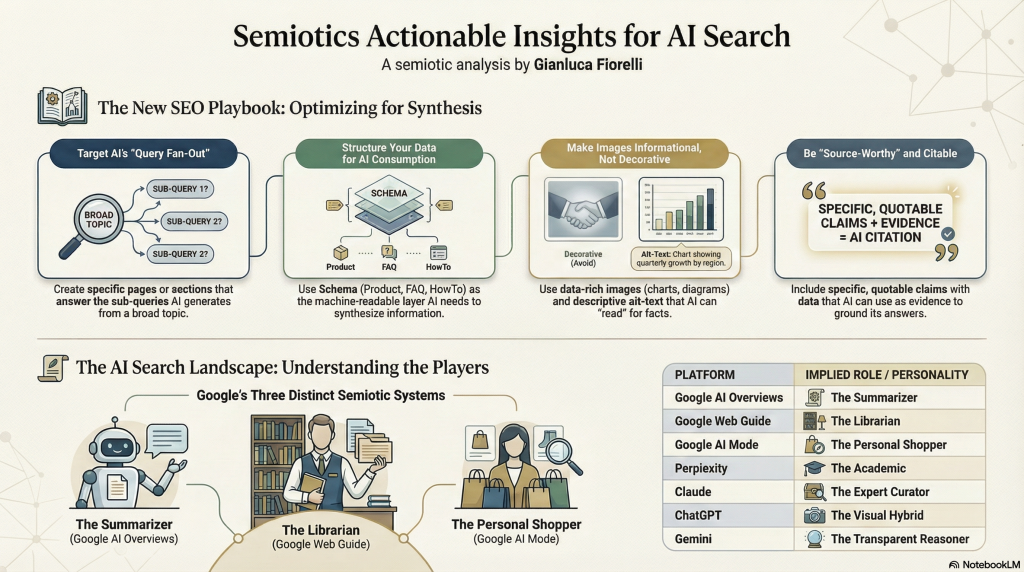
Download the infographic with the “Semiotic Insights for AI Search“.
Conclusion: The “Three Googles” and Beyond
We must now recognize three distinct Google semiotic systems, not two:
- AI Overviews: A defensive measure or a “Closed Text” designed to satisfy simple queries instantly and keep ad revenue flowing on the main SERP, which may explain why Google says that revenue from ads is growing. The implied author is the Summarizer.
- Web Guide: A transitional layer, which preserves blue links while imposing AI-generated structure. The implied author is the Librarian. This is Google’s compromise position, maintaining publisher traffic while adding organizational value.
- AI Mode: The offensive play; a fully “Synthetic” interface designed to replace the web with an immersive, agentic experience. The implied author is the Personal Shopper.
Meanwhile, the independent AI search players occupy their own semiotic positions:
- Perplexity as the Academic (prioritizing verification)
- Claude as the Expert Curator (offering dual modes of oracle and researcher)
- ChatGPT as the Visual Hybrid (merging product imagery with synthesis)
- Gemini – not really “independent”, being it Google – as the Transparent Reasoner (performing its thinking process).
For content creators, the “Search Journey” has become a battle for inclusion in the synthesis.
We are no longer fighting for a “click”; we are fighting to be the “raw material” that the AI trusts enough to cite, quote, or recommend.
Authenticity, structured data, “fan-out” alignment, and source-worthiness are the weapons in this new semiotic landscape.
The zero-click paradox remains unresolved: every successful AI answer that satisfies a user without a click is simultaneously a victory (for the user and platform) and a loss (for the publisher whose content was synthesized away).
The interfaces analyzed here represent different attempts to navigate this tension… and the semiotic choices they make reveal whose interests they ultimately serve.

Fabulous explanation with some specific direction.
This does bring forward the question of the expectations for your content, the approach to developing it, and of course how you will measure it. IF a brand can deliver their story about “the best paint for glazing”, the answer their content is used to build may be presented in an AI overview answer. However, if the brand’s answer about what the best paint for glazing is speaks to unique features of their paint (if possible), is told in a unique and authoritative fashion (reviews, etc.) and is well structured on page and in schema to the paints, the uses for it, the history of paint for glazing, colors available, pictures of it, where to purchase it, etc., they should find not only that the AI overview will begin to mimic their story, but that users will start to use this as part of their decision criteria.
Brands are still able to communicate with the buyer, they now have a “value added distributor” in the middle. The brand may not know exactly the story being told, so need to provide the structure and information to make it easier for the engines to select and repeat the brand’s view on the world.