
What he really said, what the docs confirm, and what SEOs must do now
Yes, Me Again. About Another Sundar Pichai Interview.
I know. About a month ago, I published a piece dissecting another Sundar Pichai podcast interview — the April 2026 Cheeky Pint conversation with John Collison and Elad Gil — where he dropped the “Search becomes an agent manager” framing that I argued was the most consequential thing any Google executive had said in years. I wrote ~5,000 words about it. I was fairly pleased with it.
Then Nilay Patel went and sat down with Pichai for Decoder.
So here we are. Same protagonist, different interviewer, different month, same structural problem for the open web. If this becomes a recurring column — ‘Gianluca Responds to Sundar’ — I will need a better editorial calendar. But I suspect that won’t be necessary, because at some point the velocity of what Pichai is describing will render the analysis redundant: the transformation will simply have happened, and the SEOs who read these pieces will either have adapted or not.
Let’s make sure we’re in the first group.
In this article, I will go claim-by-claim through the May 27, 2026, Decoder interview — “How Sundar Pichai Is Rethinking Google for the AI Era” — and translate each major declaration into its corresponding primary-source documentation from Google, Gemini, DeepMind, and the DOJ antitrust record. Then I will give you the practical action that follows. No punditry without proof. No alarm without instruction.
The platform shift is not a metaphor. Google’s P&L confirms it
Pichai opened by framing this moment as “bigger than the internet” or, in less pompous words, a new phase of the AI platform shift where the industry moves from model capabilities to shipping products at scale. Nilay Patel pushed back, noting that Google has been saying versions of this for three years. Pichai’s counter was specific: look at the infrastructure bets.
He’s not wrong. Alphabet’s Q4 2025 earnings (February 4, 2026) reported $63.07 billion in Search revenue, up 17% year-over-year, and announced a $175–185 billion capital expenditure commitment for 2026, almost entirely directed at AI compute infrastructure. This is not a company hedging, but a company that has decided the transition is irreversible and is pricing accordingly.
The Google I/O 2026 announcements formalized what the capex numbers implied. Gemini 3.5 Flash — Google’s newest frontier-class model, built for sustained performance in agentic and coding workflows — became the default model in AI Mode for everyone globally, while AI Mode crossed a billion monthly users and AI Overviews reached 2.5 billion. Google paired that with the biggest redesign of the Search box in over 25 years. The message is that this is no longer experimental infrastructure, but the product.
What this means for SEO
The practical implication is not “AI is coming”, but that the transition window is closing. The SEOs who treat 2026 as a year of experimentation and 2027 as the year to act seriously are making a planning error. The capex has been spent. The infrastructure is deployed. The question is no longer whether AI-mediated search becomes dominant; it is whether your content architecture is legible to that system before your competitors’ is.
Action: Audit your most important pages against Google’s AI Features documentation. Ask not whether each page ranks, but whether each page contains declarative, standalone answers to the specific sub-questions it addresses. Those are the atomic units of retrievability in AI Mode: the passages.
“Sources and links will always be there as part of it”: the most important sentence in the interview
Nilay Patel, to his considerable credit, kept pressing the question that publishers and SEOs should be pressing: what is the web’s role in Google’s AI-mediated future? The answer Pichai gave deserves forensic attention.
“Sources and links will always be there as part of it.”
The Decoder flagged this phrasing immediately as a redefinition: not “Search is built on sources and links,” — which was Google’s foundational self-description for 25 years — but “sources and links are a part of it.” Part. Of it. The open web has been demoted from substrate to feature. From load-bearing wall to decorative trim.
This is not paranoid reading, but a precise observation about what a CEO chooses to say when he knows every word will be parsed. Pichai is a careful communicator. He did not say “links are the foundation.” He said they are “part of it.” That phrasing is doing work.
The corresponding Google Search Central documentation on AI features describes “supporting links” appearing alongside AI-generated summaries, which is the same framing. Google’s official position is that AI Overviews “can surface a broader and more diverse set of links” via query fan-out. The word “broader” is doing the same rhetorical work as Pichai’s “part”: it sounds generous while describing a fundamentally different relationship between query and destination.
What the independent data actually shows
Pichai also made the claim that Google is “sending more traffic to more websites than ever before.” He offered no supporting data. Pew Research’s July 2025 study of 68,879 searches from approximately 900 US adults found that when an AI Overview appeared, only 1% of users clicked a link within the summary, and traditional link clicks dropped from 15% (no AIO) to 8% (AIO present). That is a 47% reduction in click-through rate on the organic results when AI Overviews trigger.
BrightEdge’s “AI Overviews at the One-Year Mark” report (February 2025 to February 2026) found AI Overviews triggering on approximately 48% of tracked queries; up from 30% a year earlier, a 58% increase. SE Ranking’s AI Mode research (10,000 keywords, June 2025 data) found only 14% URL-level overlap and 21.9% domain-level overlap between AI Mode citations and traditional organic top-10 results. Which means the ranking you have built is not reliably the citation you will receive.
More recent studies published while I am writing this article are offering even bigger numbers and percentages.
The “the clicks you lost were junk” defense
There is a second, subtler claim worth isolating, because it is the one most likely to survive scrutiny. In the Decoder conversation — and again when Google’s Head of Search Elizabeth Reid made the same case on Bloomberg’s Odd Lots — the argument is not only “more traffic than ever” but that the lost traffic was never worth much: low-quality clicks that bounce straight back to the results page are being filtered out, and bounce-backs are declining.
This is a cleverer defense than the first, and I want to be fair to it. Some clicks that AI Overviews absorbs genuinely are low-intent, and the user who needed one fact got it and left. Stripping those from your analytics is not a loss worth mourning. But the claim is unfalsifiable from outside: Google holds the only dataset that could confirm or refute “the clicks you lost were junk,” and Google is not sharing it. You are invited to accept that flattering reading on faith, from the party that benefits most. Treat it as you would any unaudited self-report: note it, don’t dismiss it, and don’t let it talk you out of measuring your qualified visits and assisted conversions, aka the part you can actually verify.
The patent behind the framing
The technical architecture behind all of this is documented in US12158907B1: Google’s “Thematic Search” patent, granted December 2024. It describes a system that organizes search results into thematic clusters, generates AI summaries per cluster, and surfaces “supporting links” within each theme. The user sees an answer. The links are contextual attachments to that answer. The patent is a precise technical specification of what Pichai described in plain language: links as part of it.
What this means for SEO
The strategic implication is not “links don’t matter”; in fact, Google-Extended and other crawl signals still depend on the link graph. The implication is that the citation logic of AI surfaces is decoupled from the ranking logic of organic results. You can rank #1 and not be cited. You can be cited and not rank in the top 10. These are now two separate optimization problems.
Action: Build a dual-track measurement framework. Track traditional ranking separately from the AI citation rate. Use tools that monitor AI Overview and AI Mode appearance for your target queries. Your KPI stack needs a new column.
AI Mode is not a successor to Search. It is Search, renamed and rebuilt.
Pichai described AI Mode — announced at Google I/O 2025 and now rolled out to almost all users globally without Labs sign-up — as the destination where Gemini’s frontier capabilities arrive first. He said it would “graduate” into core Search over time. The framing implies a product lifecycle: experimental surface becomes main surface. That graduation timeline is compressed.
What Pichai did not say, but the technical documentation implies, is that AI Mode operates on a fundamentally different query architecture than traditional Search. Where classic Search takes one query and returns ten blue links, AI Mode, as we all should know now, uses query fan-out. A single input query is decomposed into multiple sub-queries covering intent variants, entity reformulations, and lexical alternatives. Each sub-query is run independently. The results are synthesized into a coherent response.
The query fan-out mechanism is documented in US Patent Application US20240289407A1 (Query Variant Generation via LLMs) and in the earlier “Query Expansion by Prompting Large Language Models” paper from Google Research (May 2023). The practical effect is that a single user query touching a topic can spawn 8–12 sub-queries. If your content answers the primary query but not the sub-queries, you are invisible to the system.
This is why SE Ranking found only 14% URL-level overlap between AI Mode and the organic top 10. The sub-queries are pulling from a much wider pool of sources — and the selection criteria privilege passage-level specificity over domain authority. Google’s MUM announcement from May 2021 described the transition to “understanding information across text, images, and video in 75 languages.” AI Mode is MUM’s operational realization at commercial scale.
What this means for SEO
The content architecture implication is significant. Each H2 in your article is now potentially a response unit for a fan-out sub-query. If it contains a declarative, self-contained answer to a specific question, it is a candidate for citation. If it is a transitional section that only makes sense in the context of the full article, it is not.
Action: Audit your long-form content using a “passage test.” Extract every H2 section independently and ask: Does this section, read in isolation, answer a specific question completely? If not, restructure it so it does. This is not a change in writing quality, but a change in information architecture.
The Agent stack is already shipping. Pichai is describing a present, not a future
Pichai used the restaurant analogy — human-interface dining room versus agent-channel takeout — to describe a future where some companies specialize entirely in serving AI agents rather than human visitors. He framed it as an emerging possibility. The technical stack he was describing is already partially deployed.
Project Mariner — Google’s autonomous web-browsing agent, which had been available to Google AI Ultra subscribers at $249.99/month with support for up to 10 parallel tasks — was quietly shut down on May 4, 2026, without a public announcement, just two weeks before Google I/O 2026.
Its landing page now reads: “Thank you for using Project Mariner. It was shut down on May 4th, 2026, and its technology voyaged to other Google products.” The web-automation capabilities — navigating websites, filling forms, completing transactions without human input — have been absorbed into Gemini Agent, which Google describes as built on insights from Mariner and now supports multi-step tasks across Deep Research, Canvas, Workspace apps, and live web browsing.
The standalone product is gone; the agentic stack it pioneered is not. The A2A (Agent2Agent) protocol, originally developed by Google and donated to the Linux Foundation in April 2025, establishes the communication standard between agents using Agent Cards at /.well-known/agent-card.json.
The Universal Commerce Protocol (UCP), announced at NRF 2026 with Shopify, Etsy, Wayfair, Target, and Walmart, puts a “buy button” directly inside AI Mode and Gemini responses. The WebMCP (Web Model Context Protocol), in Chrome Canary preview since February 2026, exposes site tools to agents via a navigator.modelContext API. And critically, Google-Agent was added to Google’s official user-agent list on March 20, 2026. It is user-triggered, and by design, it ignores robots.txt.
Google’s Agent Development Kit (ADK) and the Developer’s Guide to AI Agent Protocols complete the picture: Google has shipped an end-to-end framework for agent-to-web interaction, and it is available to any developer with a Google account.
The displacement primitive no one is talking about anymore
The most structurally aggressive item in the public patent record is US12536233B1, granted January 27, 2026. It describes a system where Google evaluates publisher landing pages against a composite score — bounce rate, CTR, conversion, design quality — and, below a threshold, substitutes a Google-synthesized landing page assembled from organization data, search history, and account context. This is not theoretical. It is a granted patent.
What this means for SEO
The restaurant analogy is the right frame, but the timeline is now. You need to decide whether your digital presence is designed for the human-interface layer, the agent-channel layer, or both. Most brands are only built for the first.
Action:
- Implement the A2A Agent Card at /.well-known/agent-card.json, even if you do not have immediate agent-specific functionality to advertise.
- Instrument your server logs to capture Google-Agent traffic, because it tells you how often agents are already visiting your site.
- If you run e-commerce, evaluate the UCP integration timeline with your development team.
These are infrastructure decisions, not content decisions.
E-E-A-T is not Dead. It is now load-bearing and weighted by query class
Patel pushed Pichai on source credibility, and, specifically, how AI Mode determines which sources to trust and cite. Pichai’s answer was characteristically careful: trust is a holistic, multi-signal assessment, not a per-page editorial decision. He used the CDC as an example: its trustworthiness comes from thousands of signals across the web, not from a single declaration.
This maps precisely onto Google’s E-E-A-T framework as described in the Search Quality Rater Guidelines. Experience, Expertise, Authoritativeness, Trustworthiness; these are entity-level signals that accumulate across pages, publications, and external references. They are not page-level optimizations. They are what you build over time through consistent, accurate, well-attributed publishing.
There is a distinction buried inside Pichai’s answers that changes how you operationalize all of this. When Patel ran a live query for the “best Chromebook,” the AI Overview returned a confident, opinionated recommendation, and Pichai conceded — on the record — that it was more opinionated than it should be. In nearly the same breath, he drew a hard line around health: those queries, he said, stay anchored to authoritative answers (or so they should be). That contrast is not a throwaway. It describes a system that applies different trust thresholds to different query classes.
So E-E-A-T is not a single dial you turn up everywhere; it is a variable threshold. In Your-Money-or-Your-Life territory — health, finance, safety, civic information — the system raises the authority bar steeply, because the cost of a wrong synthesized answer is real harm. In softer, subjective commercial spaces — which Chromebook, which running shoe — it tolerates synthesis and opinion, and by Pichai’s own admission, is sometimes too willing to. The practical reading: the same content investment buys different things in different categories. In YMYL, expertise and verifiable trust signals are the price of admission. In commercial-comparison spaces, the differentiator is explicit decision criteria, real testing methodology, and attributable first-hand evidence — exactly what an over-opinionated system lacks when it gets a Chromebook recommendation wrong.
The personalization layer described in WO2025102041A1 (Google’s user-embedding patent) adds a dimension Pichai did not discuss directly: identical queries from different users can produce different sub-queries and surface different sources, because the system applies user context to query expansion. This means E-E-A-T is not just a content-quality signal, but it interacts with audience relevance signals to determine which users’ fan-out sub-queries your content is eligible to answer.
What this means for SEO
Author entity optimization is no longer a nice-to-have. It is the primary mechanism by which your content becomes associated with expertise in AI systems’ probabilistic models of the web. An article that demonstrates expertise structurally — clear attribution, linked author entity, external citations, factual precision — is processed differently than an article with equivalent prose quality but no entity signals.
The same must be said for the Organization Schema, possibly the most important, given its fundamental role, in combination with other types of structured data and the extreme accuracy of content, in disambiguating brands and building the Knowledge Graph.
Action: Build author entities properly. This means structured author pages with Schema.org Person markup, linked to social profiles and external publications; author attribution on every article; citations of primary sources that connect your content to authoritative external entities. This is entity disambiguation at the author level, and it is what feeds the holistic trust signal Pichai described. And map your content to its query class before you optimize: do not spend YMYL-grade expertise on a subjective commercial query, or apply thin commercial criteria to a health page that needs verifiable authority.
Regarding Organization Schema, structured data, and content about our brand, I recommend you read the “Branded SEO Guide” I wrote for Advanced Web Rankings.
The DOJ remedies are the most important context Pichai didn’t mention
Pichai did not discuss the antitrust case in this interview. Patel did not press it. But it is the essential backdrop for everything Pichai described, because the legal framework now governing Google’s behavior was explicitly designed around the AI transition.
Judge Mehta’s August 5, 2024, liability opinion in United States v. Google LLC (No. 20-cv-3010) found Google to be “a monopolist” in general search services, maintaining that monopoly through exclusive distribution agreements with Apple, Samsung, and mobile carriers. The market share figures cited: approximately 90% of computer searches and 95% of smartphone searches.
The September 2, 2025, remedies opinion (226 pages) rejected Chrome divestiture and Android divestiture, but imposed: a ban on exclusive distribution contracts for Google Search, Chrome, Google Assistant, and the Gemini app; mandatory sharing of certain search-index and user-interaction data with “Qualified Competitors”; mandatory five-year syndication of Search results and search text ads; and Technical Committee oversight for six years. Critically, Mehta wrote: “The emergence of generative AI has changed the course of this case.”
The December 5, 2025, final judgment capped Apple-style default agreements at one-year terms. Both Google and the DOJ have appealed. The case is live.
And the search case is not the only front. In a separate action, the April 2025 ad-tech ruling found Google had unlawfully monopolized the open-web display publisher ad-server and ad-exchange markets and illegally tied its DFP and AdX products together. I flag it not to catalog every dispute Google is fighting, but because it sits on the other side of the same squeeze: AI surfaces compress the traffic, the ad-tech structure compresses the revenue per visit that remains, and a publisher is pressured on the discovery side and the monetization side at once. Only one of those pressures is what this interview was about.
What the remedies do not require is equally important: Google does not have to share its algorithms, its ranking signals, or its trained models. The data-sharing remedy is the only structural check on Google’s AI moat — and it does not touch the competitive advantage that matters most. As Winston & Strawn’s antitrust analysis notes, the court has effectively endorsed the AI-mediated search transition while trying to keep the data layer marginally more competitive.
The CMA and EU layers
The UK Competition and Markets Authority’s October 10, 2025, Strategic Market Status designation and its January 28, 2026 Conduct Requirements (which proposed publisher opt-outs from AI training without ranking penalty) are the regulatory mechanisms more likely to deliver publisher-protective remedies than the US DOJ. The EU’s December 2025 Article 102 investigation into AI training-data compensation adds a third jurisdiction. Watch these.
What this means for SEO
The antitrust remedies tell you where the leverage points are, and where they are not. The leverage that will matter most for publishers is the CMA’s opt-out provision and the EU’s training-data compensation investigation. The DOJ case has effectively confirmed that Google will retain its AI moat; the question is what access conditions regulators can impose on the edges.
Action: Track the CMA Conduct Requirements process. If a publisher opts out of AI Mode training lands without a ranking penalty, test it carefully — but do not assume that opting out of training is the same as opting out of citation. They are different mechanisms in Google’s documentation, and conflating them is a costly error.
The Open Web is not dying. It is being reindexed
Pichai’s most honest moment in the interview was when he acknowledged the “hard question” about the symbiotic relationship between Google and the open web, or the fact that Google’s AI surfaces consume web content and return less of it as direct traffic.
He did not resolve the tension. He acknowledged it, described Google’s intent to preserve the ecosystem, and moved on. That is the honest answer, because there is no resolution available that does not conflict with Google’s product roadmap.
What the structural evidence shows is not that the open web is dying — it is that it is being reindexed as a database. The “Rethinking Search: Making Experts out of Dilettantes” paper by Donald Metzler et al. (May 2021, arXiv:2105.02274), which is as close to a Google research manifesto as anything in the public record, argued explicitly for treating the web’s content as training data for a unified model, not as a set of documents to be ranked and returned. That paper described a future where “the need for a user to sift through a list of documents” is eliminated. That future is AI Mode.
The off-domain citation evidence supports the reindexing framing. AirOps’ 2026 State of AI Search found that 85% of brand mentions in AI responses came from third-party pages rather than owned domains. Stacker’s December 2025 study found that distributing content across publications increases AI citation rate by up to 325% versus publishing only on your own site. The web is still the source layer, but the retrieval logic favors mention density across the web over authority concentration on one domain.
Notice, too, what kind of third-party content the system reaches for. Pichai’s shopping example surfaced Reddit, and that is no accident. When the question is subjective — is this thing actually good, does it hold up in real use — the synthesis layer reaches for first-person, lived-experience content over institutional consensus. That is the first “E” in E-E-A-T, Experience, behaving as a retrieval preference rather than a slogan. Google built structured-data support to expose it: DiscussionForumPosting for community threads and ProfilePage for the people behind them. The lesson is not that every brand should launch a forum, but that real test methodology, first-person evidence, and attributable creator identity are increasingly the raw material AI surfaces prefer in exactly those subjective categories.
One signal in the current Search surface runs the other way, toward publishers, not away from them. Google now treats publications a user subscribes to as preferred sources, surfacing them more prominently for that user. A subscription is a durable, first-party relationship signal the synthesis layer respects — a rare lever where building a direct, loyal audience becomes search-adjacent advantage rather than being eroded. If the AI-search era has felt like every structural change runs against publishers, this is the one to lean into.
What this means for SEO
The SEO budget allocation model needs to change. If 85% of AI citations come from third-party sources, then a content strategy that spends 100% of its budget on owned-domain content is structurally underfunded in the dimension that matters most for AI search visibility.
This does not mean abandon your site. It means build a content distribution strategy that gets your entity, your data, and your expertise represented on authoritative third-party publications; not just as links back, but as substantive contributions that establish your entity in contexts Google’s systems treat as high-trust. And treat direct-audience capture — subscriptions, follows, newsletters — as a search investment, not a separate silo.
The video layer is two doors, and both lead through YouTube
For seven sections, I have written about text, because text is where most SEOs live. But the interview that prompted this piece was itself a YouTube video, and Pichai spent real time on video search, summarizing long videos, jumping straight to the relevant moment. It would be strange to decode an interview about the future of search, conducted on YouTube, and ignore YouTube.
Two distinct reasons video belongs here, easy to conflate.
The first is classic and unglamorous: video already occupies enormous real estate in ordinary Search. Video carousels, the Videos vertical, and Shorts surfaces mean that for a large class of queries, the most visible result on the page is not a web page at all, but it is a video, and overwhelmingly a YouTube one. If you have written off video as a separate channel owned by a separate team, you have written off a slice of the SERP you are otherwise fighting hard to rank in: no AI required, and the part SEOs most often leave on the table.
The second reason is the one this article is really about. YouTube is one of the heaviest sources that AI Overviews and AI Mode draw on and present. A video is a citable, retrievable object: Google can transcribe, segment, and summarize it, then surface a specific moment as the answer to a fan-out sub-query with the video shown as the source. The decoupling from section 2 — citation logic separate from ranking logic — applies to video too, and YouTube is the corpus the system trusts most. A brand invisible on YouTube is invisible in a retrieval channel that its competitors already feed.
The architecture lesson from section 3 applies directly: just as each H2 is a candidate response unit for a fan-out sub-query, each declared key moment in a video is a candidate segment for retrieval and for the jump-to-moment experience Pichai described. Auto-detected segmentation is the fallback; creator-declared moments are what Google prefers.
What this means for SEO
Video is a second front of the same retrieval war — one door into classic SERP real estate, one door into AI synthesis — governed by the same passage-level logic. Stop running “YouTube” and “SEO” as separate programs.
Action: Treat your video presence as a first-class retrieval surface. Add chaptered descriptions and Clip / SeekToAction video structured data to videos targeting informational queries. Make sure spoken content is transcribable and that each segment’s core claim is stated in words, not only shown on screen, because a synthesis layer cannot cite a chart it cannot read aloud. Apply the passage test from section 3 to spoken segments exactly as to written H2s.
What you should actually do: eight practical imperatives
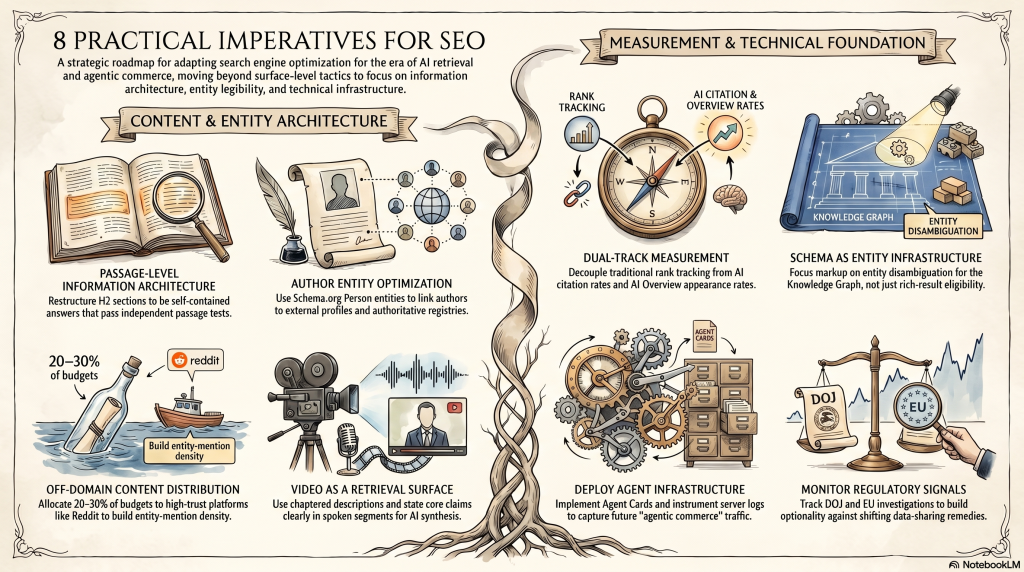
Enough translation. Here is the action layer, in priority order.
Imperative 1: Passage-level information architecture
Restructure every major piece of content so that each H2 section is a self-contained answer to a discrete question. Run a passage test: extract each section independently and ask whether it answers a complete question without context from the surrounding sections. If it does not, restructure. This is the single highest-leverage content change you can make for AI Mode retrievability.
Imperative 2: Dual-track measurement
Set up parallel tracking for traditional rank and AI citation. They are decoupled. Measure AI Overview appearance rate for your target queries, AI Mode citation rate where data is available, and traditional CTR. Track them separately and report them separately. If you are measuring only rankings, you are blind to half the game, and do not let “the lost clicks were low quality” talk you out of measuring qualified visits and assisted conversions, which is the part you can actually verify.
Imperative 3: Author entity optimization
Build Schema.org Person entities for every author, and pay the Organization Schema the same attention you devote to Product. Link them to external profiles (LinkedIn, Wikipedia, where applicable, Google Scholar if academic). Attribute every article. Connect authors to publications via sameAs markup. Author and Brand entity disambiguation is the mechanism by which E-E-A-T becomes legible to AI systems at the entity level rather than the signal level. Calibrate the depth of the effort to the query class: hardest in YMYL, lighter where the win is the decision criterion, and first-hand evidence.
Imperative 4: Agent infrastructure
Implement an A2A Agent Card at /.well-known/agent-card.json. Instrument server logs to capture Google-Agent traffic. If you run e-commerce, evaluate UCP integration and WebMCP readiness. These are six-to-twelve-month infrastructure projects. The brands that start them now will have a structural advantage when agentic commerce moves from AI Ultra users to mainstream Google accounts.
Imperative 5: Off-domain content distribution
Allocate a meaningful portion of your content budget — a minimum of 20–30% — to third-party content: guest articles, expert contributions, data studies distributed to industry publications, interviews with authoritative outlets, and genuine first-person contributions to the community platforms (Reddit chief among them), the synthesis layer reaches for. The goal is not link-building. The goal is entity-mention density across sources that AI systems treat as high-trust training data. These are different objectives that happen to overlap.
Imperative 6: Schema as entity infrastructure, not a citation lever
The framing that Schema is “the interface layer between your content and AI systems” is seductive and wrong. The Ahrefs causal study of May 2026 (1,885 pages, 30-day window) produced a null result on AI citation uplift, and not because Schema doesn’t matter, but because it was measuring the wrong layer. And Google has now said the quiet part out loud: its May 15, 2026 guide to optimizing for generative AI features confirms there is no separate AI index, that markup is not a direct ranking signal for AI retrieval, and that AI-specific tactics — bespoke “AI schema,” custom Markdown directories, llms.txt files — do not improve generative visibility. That is Google corroborating, in its own documentation, the argument I have been making.
As I have argued at length, Schema operates across three independent timescales:
- Google’s indexing pipeline (Life 1, where it feeds entity disambiguation and the Knowledge Graph).
- LLM pretraining corpora (Life 2, where it compounds indirectly through the entity stores it populates over the years).
- LLM runtime retrieval (Life 3, where JSON-LD is stripped or read as plain text, not parsed structure).
The Ahrefs study measured Life 3. That is the layer where Schema does the least. The right mental model — borrowed from my own analysis — is business registration, not advertising. You do not register a company because you expect an overnight sales boost; you register because being a formally recognizable legal entity is the foundation on which everything else sits. Schema works the same way at Life 1: it makes your entity formally legible to Google’s Knowledge Graph, and that legibility compounds across model versions and retrieval cycles on a clock measured in years, not weeks.
Action: Focus markup investment on entity disambiguation, not rich-result eligibility. That means: stable @id URIs for every entity you want the Knowledge Graph to recognize; sameAs links targeting authoritative registries (Wikidata, LinkedIn, government company registries, Wikipedia, where applicable); nested graph structures that express real relationships between entities rather than isolated per-page blocks; and the about and mention properties to declare a page’s semantic topology explicitly. Do not mark up every type for coverage. Mark up the entities your brand actually is, and make those declarations unambiguous, consistent, and externally corroborated. That is the discipline that survives rich-result deprecation cycles, Knowledge Graph cleanup events, and model version changes, because it is built on the vocabulary contract, not the product layer.
Imperative 7: Treat video as a retrieval surface
YouTube is both a high-visibility classic-search vertical and one of the most-cited sources in AI Overviews and AI Mode. Add chaptered descriptions and key-moment structured data to informational videos. State each segment’s core claim in spoken words, not only on-screen text. Apply the passage test to spoken segments the way you apply it to written H2s, and stop running “YouTube” and “SEO” as separate programs.
Imperative 8: Monitor the regulatory signals
Track the CMA Conduct Requirements process, the EU Article 102 investigation, and the DOJ remedies appeal timeline. The data-sharing remedies that Mehta imposed — index and interaction data for Qualified Competitors — could reshape the competitive AI search landscape faster than any product announcement. If a serious challenger gets access to Google-scale index data, the citation landscape changes. Build for optionality.
Closing: the same story, one chapter further
Pichai’s Decoder interview and his Cheeky Pint interview are chapters in the same book. The Cheeky Pint gave us the frame: Search becomes an agent manager. The Decoder gave us the texture: what that means for the open web, for publishers, for the source relationship, and for the political pressures Google is navigating simultaneously.
The consistent signal across both interviews is that Pichai is describing a transformation he is managing, not one he is causing. The AI Platform shift, as he keeps framing it, is something Google is adapting to, and not just building. That framing is partly true and partly defensive. Google is both riding the wave and making it larger.
What matters for SEOs is simpler than the strategic analysis. The question is not whether the transition is good or bad for the open web, but whether our content architecture, our entity representation, our video presence, and our agent-readiness are positioned to be legible to the system that is replacing traditional search, step by step, query by query.
The eight imperatives above are not a checklist to complete and forget. They are a new operating model. The sooner we start building it, the less we will need to read the next column, where I decode yet another Sundar Pichai interview… though I probably will anyway.